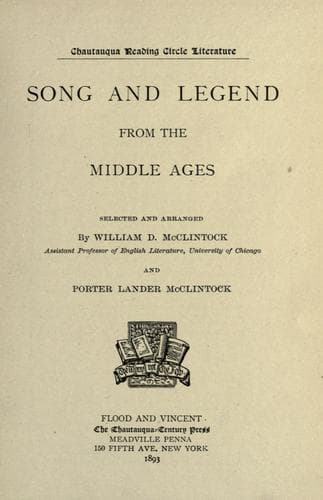
Literature, Medieval -- History and criticism; Literature, Medieval -- Translations into English
Hath Mirth(e) with him in his rout,
That follow him always about.
. . . . .
And forth without(e) word(e)s mo,[42]
In at that wicket went I tho,[43]
That idleness had opened me,
Into that garden fair to see.
[1] Eyes. [2] Dimpled. [3] Form. [4] Proportion. [5] Pustule. [6]
Pimple. [7] Is not. [8] Certainly. [9] Fringe of gold. [10] Not.
[11] Wore. [12] Plaited. [13] Neatly. [14] Doubt. [15] Combed,
ironed. [16] Day's work. [17] In fine form. [18] Pleasant. [19]
Dress. [20] Unusually, elegantly. [21] Was called. [22] Bold.
[23] Sparing. [24] Name. [25] Great and small. [26] Chiefly. [27]
Attend. [29] Comb. [30] Plait. [31] Fetched. [32] Were grown to
a height. [33] The pictures on the outside of the wall. [34]
Scarve.[35] Joyful, pleasant. [36] Unusual, queer. [37] Retinue.
[38] Pleasure. [39] To. [40] India. [41] Fairest of all. [42]
More. [43] Then.
After wandering about the garden hearing the birds and getting
acquainted with the inhabitants, he saw
Among a thousand thing(e)s mo[1]
A roser [2] charged full of roses,
That with an hedge about enclosed is.
Tho[3] had I such lust[4] and envy,
That for Paris nor for Pavie,
Nolde[5]I have left to go at see
There greatest heap of roses be.
When I was with this rage hent[6]
That caught hath many a man and shent[7]
Toward the roser I gan go.
And when I was not far therefro,[8]
The savor of the roses sweet
Me smote right to the heart(e) root
As I had all embalmed be.
And if I had ne[9] endoubted[10] me
To have been hated or assailed,
Me thank(e)s[11] would I not been failed
To pull a rose of all that rout,[12]
To bear(en) in my hand about
And smell(en) to it where I went;
But ever I dreaded me to repent,
And lest it grieved or forthought[13]
The lord that thilke[14] garden wrought,
Of roses there were great(e) wone,[15]
So fair(e) waxe [16] never in Rone.[17]
Of knop(e)s[18] close,[19] some saw I there
And some well better waxen[20] were,
And some there be of other moison[21]
That drew(e) nigh to their season,
And sped 'em fast(e) for to spread;
I love well such roses red;
For broad[22] roses, and open also,
Be passed in a day or two;
But knop(e)s[18] will(e) fresh(e) be
Two day(e)s at the least, or three,
The knop(e)s greatly liked[23]me,
For fairer may there no man see
Whoso might have one of all
It aught him be full lief[24]withall.
Might I one garland of 'em get
For no riches I would it let.[25]
Among the knop(e)s I chose one
So fair, that of the remnant none
Ne prize I half so well as it,
When I avise[26] it is my wit.
In it so well was enlumined
With color red, as well y-fined[27]
As nature couthe[28]it make fair.
And it had leaves well four pair,
That Kynde[29] hath set through his knowing
About the red roses springing.
The stalk(e) was as rush(e) right
And thereon stood the knop upright,
That it ne bowed upon no side,
The sweet(e) smell(e) sprang so wide
That it did[30] all the place about.
When I had smelled the savor sweet
No will had I from thence yet go
Public-domain text, read in full here on John Shaqi.
Reviews
Reviews
No reviews yet
Be the first to share your thoughts on this work.
Join the Discussion
Join the discussion
Sign in to leave a comment or review.
Sign InorCreate an account