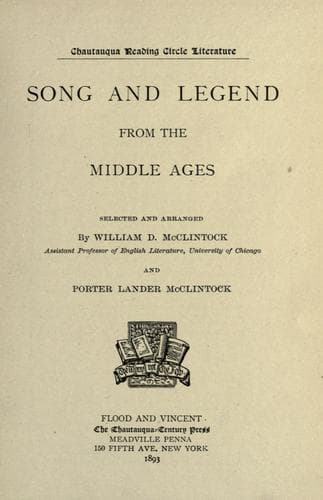
Literature, Medieval -- History and criticism; Literature, Medieval -- Translations into English
Hildebrand, son of Herbrand, spake again:
"Thine arms show that in this land thou couldst not gain
A liberal leader or a royal friend.
Now well away. Great God, fate's evil end!
For sixty years, exile in stranger lands,
Summer and winter with spear-darting bands,
Never once leg bound within city wall,
I come back by my own son's hand to fall,
Hewn by his sword, or be his murderer,--
But if thy strength hold, thou canst readily
Win of the brave his arms, spoil of the slain,
When thine by right." Said Hildebrand, "Now, worst
Of Ostrogoths be he who holds me back! My heart is for the fray.
Judge comrades who look on, which of us wins
The fame, best throws the dart, and earns the spoil."
The ashen spears then sped, stuck in the shields
With their keen points, and down on the white shields
The heavy axes rang with sounding blows,
Shattering their rims, the flesh behind stood firm. . . .
--Tr. by Morley.
In the second, or Middle High German Period, the heroic legends
of early times were revived and formed the subject matter of many
epic and semi epic poems. These legends have been classified into
six several cycles of romances:[1]
[1] Cf. Morley's "English Writers." Vol. III., pp. 152-4.
1. The Frankish cycle contains the stories of Siegfried, the
Sigurd of the Scandinavian tradition.
2. The Burgundian cycle contains King Gunther.
3. The Ostrogoth cycle contains Dietrich, Theodoric, and
Hildebrand.
4. The Hungarian cycle, to which belongs Attila or Etzel, and
Rudiger.
5. The Lombard cycle, to which belong King Rother, King Otnit,
and Wolfdietrich.
6. The North Saxon cycle, to which belongs the tale of Gudrun.
The two most important of all the epics based upon these cycles
are the Gudrun and the Niebelungenlied. The latter is the more
comprehensive, national, and famous. It includes and unifies all
the tales from the first four cycles of heroic legends.[1] The
whole of German art, literature, and tradition is full of
reflections of this poem. The best scholarship has concluded that
the poem is not the work of a single author, but, like other folk
epics, an edited collection of songs. The work was finished about
1190-1210. It consists of two greater parts, (1) the "Death of
Siegfried" and (2) the "Vengeance of Kriemhild".
[1] See Kluge, "Geschichte der Deutschen National-Literature," p.
33.
From the "Niebelungenlied". The first song in the poem gives us
Kriemhild's foreboding dream.
KRIEMHILD'S DREAM.
Stanzas 1-19.
In stories of our fathers high marvels we are told
Of champions well approved in perils manifold.
Of feasts and merry meetings, of weeping and of wail,
And deeds of gallant daring I'll tell you in my tale.
In Burgundy there flourish'd a maid so fair to see,
That in all the world together a fairer could not be.
This maiden's name was Kriemhild; through her in dismal strife
Full many a proudest warrior thereafter lost his life.
Public-domain text, read in full here on John Shaqi.
Reviews
Reviews
No reviews yet
Be the first to share your thoughts on this work.
Join the Discussion
Join the discussion
Sign in to leave a comment or review.
Sign InorCreate an account