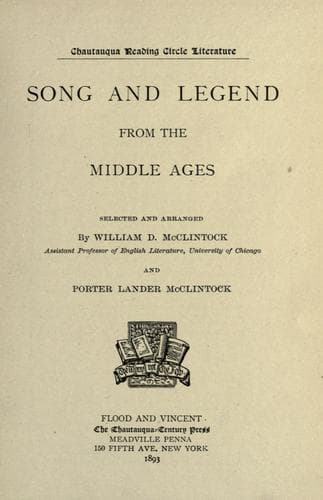
Literature, Medieval -- History and criticism; Literature, Medieval -- Translations into English
She thus bespake her husband, "Give up that chace of thine.
I dreamt last night of evil, how two fierce forest swine
Over the heath pursued thee; the flowers turn'd bloody red.
I cannot help thus weeping; I'm chill'd with mortal dread.
I fear some secret treason, and cannot lose thee hence,
Lest malice should be borne thee from misconceiv'd offence.
Stay, my beloved Siegfried, take not my words amiss.
'T is the true love I bear thee that bids me counsel this."
"Back shall I be shortly, my own beloved mate.
Not a soul in Rhineland know I, who bears me hate.
I'm well with all thy kinsmen; they're all my firm allies;
Nor have I from any e'er deserv'd otherwise."
"Nay! do not, dearest Siegfried! 't is e'en thy death I dread.
Last night I dreamt, two mountains fell thundering on thy head,
And I no more beheld thee; if thou from me wilt go,
My heart will sure be breaking with bitterness of woe."
Round her peerless body his clasping arms he threw;
Lovingly he kiss'd her, that faithful wife and true;
Then took his leave, and parted;--in a moment all was o'er--
Living, alas poor lady! she saw him never more.
In the chase Siegfried prefers to hunt with a single limehound.
But he achieves most marvelous feats of skill and strength.
Stanzas 962-971.
All, that the limehound started, anon with mighty hand
Were slain by noble Siegfried the chief of Netherland.
No beast could there outrun him, so swift is steed could race;
He won from all high praises for mastery in the chace.
Whatever he attempted, he went the best before.
The first beast he encounter'd was a fierce half-bred boar.
Him with a mighty death-stroke he stretch'd upon the ground;
Just after in a thicket a lion huge he found.
Him the limehound started; his bow Sir Siegfried drew;
With a keen-headed arrow he shot the lion through.
But three faint bounds thereafter the dying monster made.
His wond'ring fellow-huntsmen thanks to Sir Siegfried paid.
Then one upon another a buffalo, an elk
He slew, four strong ureoxen, and last a savage shelk.
No beast, how swift soever, could leave his steed behind;
Scarcely their speed could profit the flying hart or hind
. . . . . . .
They heard then all about them, throughout those forest grounds,
Such shouting and such baying of huntsmen and of hounds,
That hill and wood re-echoed with the wild uproar.
Th' attendants had uncoupled four and twenty dogs or more.
Then full many a monster was doom'd his last to groan.
They thought with glad expectance to challenge for their own
The praise for the best hunting; but lower sunk their pride,
When to the tryst-fire shortly they saw Sir Siegfried ride.
The hunting now was over for the most part at least;
Game was brought in plenty and skins of many a beast
To the place of meeting, and laid the hearth before.
Ah! to the busy kitchen what full supplies they bore!
. . . . . . . . . . . . .
Public-domain text, read in full here on John Shaqi.
Reviews
Reviews
No reviews yet
Be the first to share your thoughts on this work.
Join the Discussion
Join the discussion
Sign in to leave a comment or review.
Sign InorCreate an account