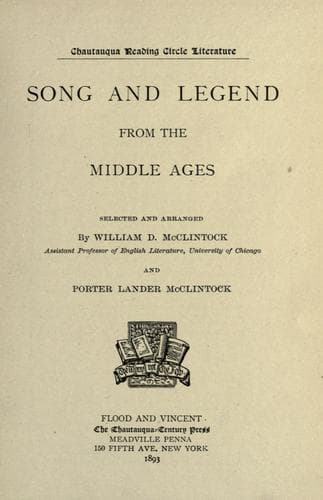
Literature, Medieval -- History and criticism; Literature, Medieval -- Translations into English
The soft west wind, returning, brings again
Its lovely family of herbs and flowers;
Progne's gay notes and Philomela's strain
Vary the dance of springtide's rosy hours;
And joyously o'er every field and plain
Glows the bright smile that greets them from above,
And the warm spirit of reviving love
Breathes in the air and murmurs from the main.
But tears and sorrowing sighs, which gushingly
Pour from the secret chambers of my heart,
Are all that spring returning brings to me;
And in the modest smile, or glance of art,
The song of birds, the bloom of heath and tree,
A desert's rugged tract and savage forms I see.
--Greene.
SONNET LII. HE REVISITS VAUCLUSE.
I feel the well-known breeze, and the sweet hill
Again appears, where rose that beauteous light,
Which, while Heaven willed it, met my eyes, then bright
With gladness, but now dimmed with many an ill.
Vain hopes! weak thoughts! Now, turbid is the rill;
The flowers have drooped; and she hath ta'en her flight
From the cold nest, which once, in proud delight,
Living and dying, I had hoped to fill:
I hoped, in these retreats, and in the blaze
Of her fair eyes, which have consumed my heart,
To taste the sweet reward of troubled days.
Thou, whom I serve, how hard and proud thou art!
Erewhile, thy flame consumed me; now, I mourn
Over the ashes which have ceased to burn.
--Roscoe.
CANZONE III. UNDER VARIOUS ALLEGORIES HE PAINTS THE VIRTUE,
BEAUTY, AND UNTIMELY DEATH OF LAURA.
While at my window late I stood alone,
So new and many things there cross'd my sight,
To view them I had almost weary grown.
A dappled mind appear'd upon the right,
In aspect gentle, yet of stately stride,
By two swift greyhounds chased, a black and white,
Who tore in the poor side
Of that fair creature wounds so deep and wide,
That soon they forced her where ravine and rock
The onward passage block: Then triumph'd
Death her matchless beauties o'er,
And left me lonely there her sad fate to deplore.
. . . . . . .
In a fair grove a bright young laurel made--
Surely to Paradise the plant belongs!--
Of sacred boughs a pleasant summer shade,
From whose green depths there issued so sweet songs
Of various birds, and many a rare delight
Of eye and ear, what marvel from the world
They stole my senses quite!
While still I gazed, the heavens grew black around,
The fatal lightning flash'd, and sudden hurl'd,
Uprooted to the ground, That blessied birth.
Alas! for it laid low,
And its dear shade whose like we ne'er again shall know.
. . . . . . . . . . . . . .
A lovely and rare bird within the wood,
Whose crest with gold, whose wings with purple gleam'd,
Alone, but proudly soaring, next I view'd,
Of heavenly and immortal birth which seem'd,
Flitting now here, now there, until it stood
Where buried fount and broken laurel lay,
And sadly seeing there
The fallen trunk, the boughs all stripp'd and bare,
The channel dried--for all things to decay
So tend-it turn'd away
As if in angry scorn, and instant fled,
Public-domain text, read in full here on John Shaqi.
Reviews
Reviews
No reviews yet
Be the first to share your thoughts on this work.
Elsewhere in the archive
Join the Discussion
Join the discussion
Sign in to leave a comment or review.
Sign InorCreate an account