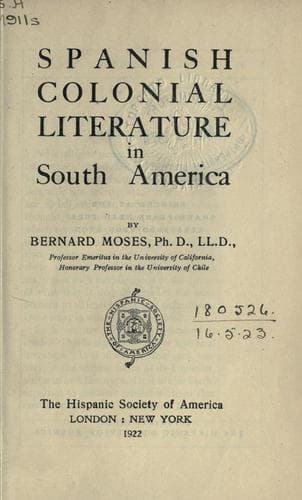
Spanish colonial literature in South AmericaMoses, Bernard
History
Spanish colonial literature in South America
Moses, Bernard
Spanish American literature -- History and criticism
In 1612 he was elected an alcalde in the municipal council of Santiago,
and later, enjoying the confidence of Governor Ribera, he was entrusted
with various public commissions. In March of the same year, 1612, a
new policy respecting the Indians was proclaimed. It provided that
the government should adopt a plan of defence, instead of continuing
campaigns for invading Araucanian territory, and the river Biobio should
be the boundary line between the territory of the Spaniards and that
of the Indians. The Spaniards were to maintain their forces armed and
equipped, but they were to be used only for defensive operations. Águila,
now an encomendero at Santiago, was the most vigorous opponent of this
policy; and the Jesuit Valdivia, the most prominent advocate of it,
complained of Águila’s opposition in his memorial to the king.
In the years subsequent to his military activity there is little known
of the events of Águila’s life, but, after forty years in Chile, he
published in 1630 at Lima his _Compendio historial del descubrimiento,
conquista y guerra del reino de Chile_.
V
[Sidenote: Alonso de Ovalle]
[Sidenote: Ovalle becomes a Jesuit]
Alonso de Ovalle became more widely known than most of the early colonial
historians, partly from the fact that his _Histórica relación del reino
de Chile_ was one of the first Chilean books of which translations
were published in Europe. The author was a son of Francisco Rodríguez
del Manzano de Ovalle, who was the holder of an entailed estate in
Salamanca, and who went to Chile in command of certain troops that
had been equipped at Lisbon. On this expedition he was accompanied by
his cousin, Diego Valdez de la Vanda, who had been appointed governor
of Buenos Aires. In Santiago Rodríguez del Manzano de Ovalle married
María Pastene, a daughter of Juan Bautista Pastene, recognized for his
services under Valdivia. Two sons of this marriage, Alonso and Jerónimo,
born in the beginning of the seventeenth century, received instruction
in the Jesuits’ school. By reason of their wealth as compared with the
majority of Santiago’s primitive society they were conspicuous figures
in the town. They were noteworthy for their fine horses with rich
trappings, their ostentatious dress and the richness of their jewelry.
The gentleness and docility of Alonso, his inclination to religious
reflection and his wealth naturally suggested to his Jesuit instructors
the desirability of attracting him to enter the order. Their zeal in this
matter was stimulated by the knowledge that Alonso’s father was making
arrangements to send him to Spain to take possession of the estate in
Salamanca. The necessary steps for his initiation were hastily taken, and
without the knowledge of his parents he took the vows and assumed the
obligations of the Jesuits.
[Sidenote: Ovalle as missionary and professor]
Public-domain text, read in full here on John Shaqi.
Reviews
Reviews
No reviews yet
Be the first to share your thoughts on this work.
Elsewhere in the archive
Join the Discussion
Join the discussion
Sign in to leave a comment or review.
Sign InorCreate an account