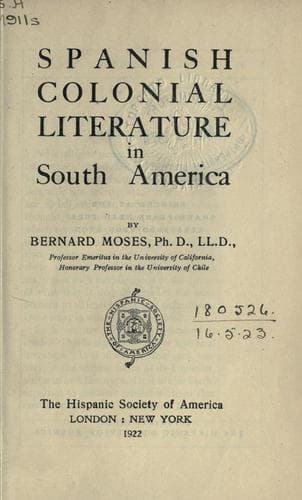
Spanish colonial literature in South AmericaMoses, Bernard
History
Spanish colonial literature in South America
Moses, Bernard
Spanish American literature -- History and criticism
of his family. Holding in memory this long and faithful friendship, and
in possession of the documents relating to Sotomayor’s political career,
Caro de Torres wrote his _Relación de los servicios de Don Alonso de
Sotomayor_.[99]
[Sidenote: Torres’ _Relación_]
[Sidenote: Torres on military orders]
The significance of this work is solely in the importance of the subject,
in the fact that it involves in its narrative a large number of events
relating to one of Chile’s more distinguished governors. It deals with
three phases of Sotomayor’s life: his career before he became governor,
his administration in Chile, and his activity as governor-general of
Panama, together with his retirement in Spain, but all with a minimum
of literary skill and method. About half of the bulk of the book
consists of documents introduced into the text. These documents, while
they interrupt the narrative, give a certain importance to the work. In
1629, nine years after the appearance of the _Relación_, Caro de Torres
published in Madrid an imposing folio on the _Historia de las órdenes
militares de Santiago, Calatrava y Alcántara, desde su fundación hasta
el rey don Felipe segundo, administrador perpétuo de ellas_. In spite
of the fact that this book would not seem to appeal to many persons, it
met a noteworthy approval in its day, and added to the reputation of its
author.[100]
IV
[Sidenote: Águila’s _Compendio historial_]
[Sidenote: Águila joins the troops for Chile]
In Chile the Araucanian Indians continued yet many decades to menace the
security of Spanish settlers, and the campaigns against them continued
to furnish a theme for writers. A product of this state of affairs was
Melchor Xufré del Águila’s _Compendio historial del descubrimiento,
conquista y guerra del reino de Chile_. Águila accompanied at his own
expense the expedition to Peru led by García Hurtado de Mendoza, after
that officer had been appointed to the post of viceroy. On their arrival
in America the members of the expedition were discouraged by the bad news
received concerning the attitude assumed by the Indians. Águila joined
the troops that were sent to Chile. He entered upon the campaign under
an agreement with the viceroy that he would pay his own expenses, and
that he might withdraw and return to Peru whenever he desired. Later,
however, he sought from the king a certain remuneration for his services,
preferably in the shape of a governmental office or the position of a
corregidor. He had not only rendered military services but, at his own
expense, had caused supplies to be introduced into Concepción to avert
impending famine.
At the time of his withdrawal from the campaign against the rebellious
Indians he had been wounded several times, and had had one of his legs
broken. In his retirement he began to write of the events in which he had
had part and those that had happened under his observation.
[Sidenote: Chilean defensive policy]
Public-domain text, read in full here on John Shaqi.
Reviews
Reviews
No reviews yet
Be the first to share your thoughts on this work.
Elsewhere in the archive
Join the Discussion
Join the discussion
Sign in to leave a comment or review.
Sign InorCreate an account