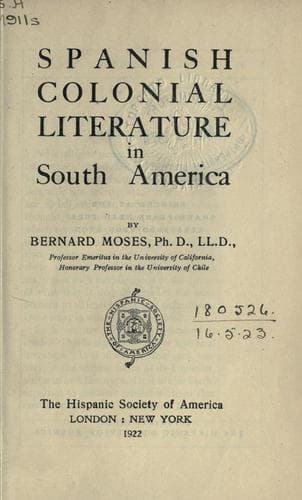
Spanish colonial literature in South AmericaMoses, Bernard
History
Spanish colonial literature in South America
Moses, Bernard
Spanish American literature -- History and criticism
About the middle of the seventeenth century a friar of the Augustinian
order, Miguel de Aguirre, became conspicuous at Lima not only as the
author of the _Población de Valdivia_, but also as a devotee of the
Virgin of Copacabana. He was born at Chuquisaca, and took his religious
vows very early. In 1641 he appeared at Lima, and entered the monastery
of his order in that city, and became there professor of arts and
theology. The distinction achieved by his lectures caused him to be
appointed to a professorship in the University of San Marcos. He became
also censor of the Inquisition. Pedro de Toledo y Leiva, Marqués de
Mancera (1639-1648) was then the viceroy of Peru. In order to provide
defence against the threatened invasion of the Dutch, he imposed various
taxes and called upon certain institutions to make contributions. Aguirre
was present at a meeting of the University of San Marcos on October
10, 1641, called to reply to the viceroy’s letter. Mancera’s plans
comprehended the building of a wall about Lima, and equipping a number
of warships to be sent to the coast of Chile. The defence appeared to
be especially necessary in view of the fact that the Dutch had taken
possession of Valdivia and intended to establish themselves within the
limits of Chilean territory. The viceroy fitted out a squadron of twelve
vessels, carrying eighteen hundred men and one hundred and eighty-eight
guns. These vessels set sail on December 31, 1644, and arrived at their
destination on the 6th of February, 1645, but before their arrival the
enemy had departed. The minute knowledge of the enterprise displayed by
Aguirre in his _Población de Valdivia_ (Lima, 1647), has suggested that,
with other ecclesiastics, he was a member of the expedition; in fact his
known advisory relation to the viceroy has given a certain support to the
opinion that he occupied an official position.
[Sidenote: The Virgin of Copacabana]
For three years longer, until the end of Mancera’s term in 1648, Aguirre
continued to perform his professorial duties at the university, and
when he resigned in that year, it was probably in anticipation of his
accompanying the viceroy to Spain; for in 1650 Mancera left Lima for
Madrid, taking Aguirre with him as his confessor. Aguirre for his
religious consolation and in order to be fortified against possible
ill fortune on the voyage, took with him an image of Nuestra Señora de
Copacabana. He proposed, moreover, to establish in Europe the cult of Our
Lady of Copacabana, in which the Indians about Lake Titicaca had appeared
to find a large measure of religious satisfaction.[104]
[Sidenote: Aguirre in Spain and Italy]
Public-domain text, read in full here on John Shaqi.
Reviews
Reviews
No reviews yet
Be the first to share your thoughts on this work.
Elsewhere in the archive
Join the Discussion
Join the discussion
Sign in to leave a comment or review.
Sign InorCreate an account