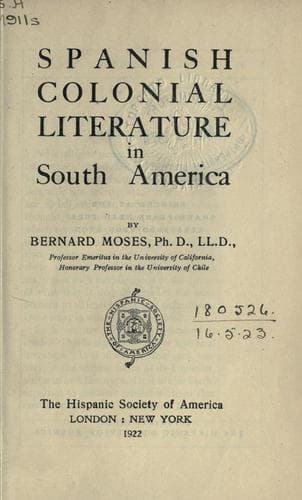
Spanish colonial literature in South AmericaMoses, Bernard
History
Spanish colonial literature in South America
Moses, Bernard
Spanish American literature -- History and criticism
“Misfortunes seldom come alone; and so it happened to this afflicted
city, which, instead of receiving comfort from the approaching day, no
sooner did it appear, when the noise of drums and trumpets gave a warm
alarm of the enemy being at hand. Here the confusion increased; for now
the concern was not for the loss of others, but for every one’s own
safety, the danger threatening them so immediately. There was nothing
but disorder, no counsel nor resolution being to be found in the wisest.
They could not defend themselves, because they were overpowered in
numbers by the enemy; and the retreat, though necessary, was difficult,
because of the approach of the Indians. In this hard conflict at last
the resolution that prevailed was to abandon the city without pretending
to save any thing but their lives. They leave the city then, and all
the gold they had got together in such quantities; they go out in long
files, the mothers helping their little children along; the way that they
undertook was to the city of St. Iago, a long one, in which many rivers
were to be crossed, and hard passes to be gone through: this labour was
accompanied with the perpetual fright of the enemy’s pursuing them. Who
can relate the hardships of hunger and other sufferings through so
long a tract of mountains, deserts, and uninhabited countries? How the
women, the children, the old men could bear the fatigue, we must leave
to imagination to represent the true idea of these misfortunes! Let us,
therefore, return to the Indians. The Spaniards had hardly made an end of
abandoning the city when the Indians entered it; and not being able to
execute their rage upon the inhabitants, they did it upon the houses, to
which they set fire, and consumed them to the very foundation, killing
even the very animals which the Spaniards left behind them. Thus was lost
the city most abounding in gold and situated in the most populous part
of the Indian country; for it is said there were not less than a hundred
thousand Indians with their families, who were all employed in gathering
gold for the Spaniards, whom they enriched to that degree that Pedro de
Valdivia, if he had lived, would have had fifty thousand crowns of gold a
year, and others twenty and thirty thousand.”[103]
VI
[Sidenote: _Población de Valdivia_]
[Sidenote: Aguirre]
[Sidenote: Expedition against the Dutch]
Public-domain text, read in full here on John Shaqi.
Reviews
Reviews
No reviews yet
Be the first to share your thoughts on this work.
Elsewhere in the archive
Join the Discussion
Join the discussion
Sign in to leave a comment or review.
Sign InorCreate an account