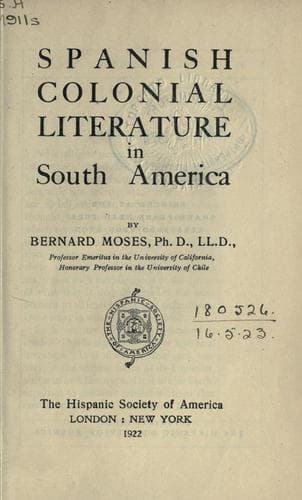
Spanish colonial literature in South AmericaMoses, Bernard
History
Spanish colonial literature in South America
Moses, Bernard
Spanish American literature -- History and criticism
The policy of the European inhabitants of Chile respecting the Indians,
before the end of the sixteenth century, was simply to subdue them.
With the beginning of the seventeenth century it became necessary
to review this policy. The Indians had not been conquered; in fact,
many of the towns and military posts established by the Spaniards had
been swept away; the settlers had either fled or been destroyed; and
whatever property they had accumulated had been lost. Two main questions
had to be considered: should the Spaniards persist in the war for
conquest? and what should be the treatment of the Indians captured or
under Spanish domination? The encomenderos were in favour of holding
them as slaves, but another party advocated a more humane policy
and the adoption of an attitude of military defence. Opinions and
discussions on these questions determined the political atmosphere of
Chile in the first half of the seventeenth century. There were formed
certain definite propositions: that the Indians should be released
from personal servitude, or slavery, but that the existing relation
should be maintained for two years, a period to be used in collecting
voluntary labourers; that during this period all work in the mines
should be suspended, and there should be paid to the Indians elsewhere
engaged a daily wage, fixed beforehand, for their labour; that a new
rule respecting tribute should be published; that the Indian prisoners
held as slaves should be liberated, but that the three hundred held in
Lima should remain there until the end of the war; and that negotiations
should be undertaken with the view of introducing negroes to replace the
Indians.[106]
[Sidenote: Opposing views]
Although these recommendations received the enthusiastic approval of the
viceroy, it was found to be impossible to carry them out in Chile. Many
of the Indians, if left free, were averse to labour of any kind under
any conditions; the encomenderos resisted every attempt to liberate
them; still the audiencia of Chile, when it was established in 1609, was
instructed to abolish the personal service of the Indians. This order,
however, brought a reaction against the movement for emancipation, and
this reaction found a vigorous supporter in Francisco Lazo de la Vega,
when he became governor of Chile in 1629. He was an old soldier, who saw
a remedy for the unfortunate condition of affairs only in the exercise of
a sufficient amount of force to bring the Indians into subjection, and
consequently repudiated the plan of a defensive war.[107]
[Sidenote: Proposed state of troops]
Public-domain text, read in full here on John Shaqi.
Reviews
Reviews
No reviews yet
Be the first to share your thoughts on this work.
Elsewhere in the archive
Join the Discussion
Join the discussion
Sign in to leave a comment or review.
Sign InorCreate an account