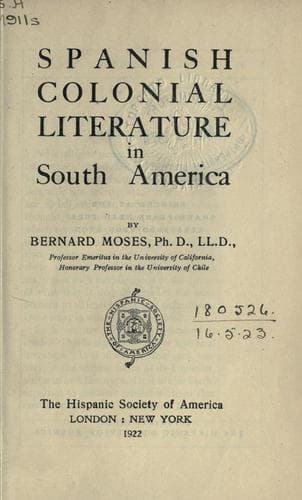
Spanish colonial literature in South AmericaMoses, Bernard
History
Spanish colonial literature in South America
Moses, Bernard
Spanish American literature -- History and criticism
In writing this account of the great river of the Amazons Acuña
recognized that he was not the first to make this journey. He was aware
that Orellana and Lope de Aguirre had preceded him. He referred also to
various other attempts that had failed. In making clear and apparently
well grounded statements of physical conditions as they doubtless
appeared to him, the author at the same time shows an inclination to
accept as true the marvellous tales that were told him. His mind received
calmly the story of “a nation of dwarfs as small as little children,” and
another story of a “people who all have their feet turned the wrong way,
so that a person who did not know them, in following their footsteps,
would always walk away from them.”[118] He finds, moreover, “the proofs
of the existence of the province of the Amazons on this river are so
numerous, and so strong, that it would be a want of common faith not to
give them credit.”[119]
[Sidenote: Perpetuation of the race]
“There is no saying more common than that these women inhabit a province
on the river, and it is not credible that a lie could have been spread
throughout so many languages, and so many nations, with such an
appearance of truth.[120] The Amazon women are of great valour, and they
have always preserved themselves without the ordinary intercourse with
men; and even when these, by agreement, come every year to their land,
they receive them with arms in their hands, such as bows and arrows,
which they brandish about for some time, until they are satisfied that
the Indians come with peaceful intentions. They then drop their arms and
go down to the canoes of their guests, where each one chooses the hammock
that is nearest at hand (these being the beds in which they sleep); they
then take them to their houses, and, hanging them in a place where their
owners know them, they receive the Indians as guests for a few days.
After this the Indians return to their own country, repeating these
visits every year at the same season. The daughters who are born from
this intercourse are preserved and brought up by the Amazons themselves,
as they are destined to inherit their valour, and the customs of the
nation, but it is not so certain what they do with the sons.”[121]
IV
[Sidenote: Torres Bollo]
Torres Bollo and Calancha were two important writers who dealt
extensively with the progress of the religious orders.
[Sidenote: Torres Bollo’s offices]
[Sidenote: Torres Bollo in New Granada and Paraguay]
Public-domain text, read in full here on John Shaqi.
Reviews
Reviews
No reviews yet
Be the first to share your thoughts on this work.
Elsewhere in the archive
Join the Discussion
Join the discussion
Sign in to leave a comment or review.
Sign InorCreate an account