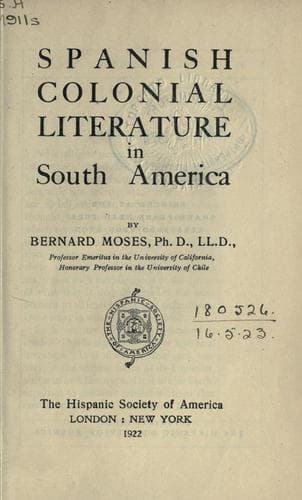
Spanish colonial literature in South AmericaMoses, Bernard
History
Spanish colonial literature in South America
Moses, Bernard
Spanish American literature -- History and criticism
Calancha’s principal and most widely known work is the first volume
of the _Crónica moralizada del orden de S. Agustín en el Perú_. It was
published in Barcelona in 1639. A second volume was completed about 1653,
and the next year the author died suddenly at the age of seventy.[122]
Under the title of _Histoire du Pérou_, a French translation of the first
volume appeared in Toulouse in 1653.[123]
[Sidenote: Topics of Calancha’s _Crónica_]
Calancha’s first volume embraces the history of the Augustinian order in
South America during nearly a hundred years following 1551; the founding
of monasteries of the order in Peru, Ecuador, New Granada, and Chile; the
succession of priors, and the monks and nuns who were distinguished by
their labours or their virtues. It deals, moreover, with the topography
and natural products of the country; with the antiquities and traditions
of the Inca empire; with the events of the conquest and the internal
conflicts of the invaders. The history of the Augustinians in Peru begins
with the landing of twelve friars at Callao near the end of May, 1551. A
month later these friars were installed in a house purchased with funds
from the royal treasury.
[Sidenote: Study of astrology]
Besides his inquiries in ecclesiastical history Calancha was attracted
to the study of astrology, from which he presumed to indicate the
forces determining the general character of different aggregations of
inhabitants within his horizon. Here is the diagnosis of the inhabitants
of Potosí:
“In Potosí the signs of Libra and Venus predominate, and thus most
of those who live there incline to be covetous, friends of music and
festivities, zealous in the pursuit of riches, and somewhat given to
lust; their planets are Jupiter and Mercury; the latter inclines them to
be wise, prudent and intelligent in their trade and exchanges, and by
Jupiter to be magnanimous and of liberal minds.”[124]
[Sidenote: Quality of the _Crónica_]
The delusions of his age were naturally shared by Calancha. His faith,
his superstitions, and his disposition to see the law of nature set aside
in a miracle at any moment seem to men of this more critical century
incompatible with his evident learning and intellectual ability. Yet with
all these qualities that seem to indicate a certain mental simplicity, he
wrote a great narrative. The nine hundred and twenty-two double-column
folio pages of the first volume, barring the record of the delusions and
superstitions of his times, do not suggest weakness, but remain as a
monument of intellectual vigor.[125]
VI
[Sidenote: Bernabé Cobo]
Public-domain text, read in full here on John Shaqi.
Reviews
Reviews
No reviews yet
Be the first to share your thoughts on this work.
Elsewhere in the archive
Join the Discussion
Join the discussion
Sign in to leave a comment or review.
Sign InorCreate an account