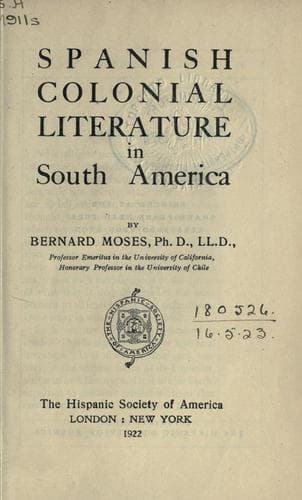
Spanish colonial literature in South AmericaMoses, Bernard
History
Spanish colonial literature in South America
Moses, Bernard
Spanish American literature -- History and criticism
Returning from Spain, he arrived at Lima on the 22nd of November,
1604, accompanied by fifty Jesuits, to be distributed among the three
provinces. The inspector Páez, with whom Torres had been associated,
had been appointed provincial, and Torres was now sent to New Granada
to organize the newly created province. On this journey he visited the
religious house at Cartagena, which he had founded in returning from
Europe, and at Bogotá he created the establishment called Santa Clara.
After three years spent in New Granada, visiting various parts of the
country, he returned to Lima in 1607, and then went to the region of the
south-east to organize the province of Paraguay. This province was made
to embrace Chile besides Tucumán and the region about the great rivers
that flow into the Río de la Plata, but Chile soon acquired a measure of
independence as a vice-province. He continued his labours as provincial
until 1618, when he retired to Buenos Aires. Later he was called to
Chuquisaca, and died there August 8, 1638.
[Sidenote: Torres Bollo’s principal works]
Torres’ practical achievements established his reputation during his
lifetime, and his writings have contributed to maintain the memory of his
distinction in later generations. His principal work was _Comentarios
del Perú; breve relación del fruto que se recoge de los indios_, which
appeared first in Italian (Rome, 1603) and immediately afterwards in
Spanish, Latin, French, and German. He is sometimes referred to as having
also written a _Historia del Perú y de los acontecimientos notables
acaecidos en los últimos años_, but this is really the same work as
the one quoted above. His other writings, though less well known, are
important as historical sources.
V
[Sidenote: Antonio de la Calancha]
Among the historians of the first part of the seventeenth century, who
wrote on the affairs of Peru, Antonio de la Calancha occupies a place of
special prominence. He was born in 1584 in Chuquisaca. His father was
Captain Francisco de la Calancha, a Spaniard; his mother was a creole.
At the age of fourteen he became a member of the Augustinian order in
his native city. About the same time Miguel de Aguirre, the author of
_Población de Valdivia_, was born in Chuquisaca, and also adopted the
habit of the Augustinians. From the monastery Calancha went to the
Augustinian college of San Ildefonso in Lima. Throughout his life the
monastery, either in Lima or elsewhere, remained the principal centre
of his activity, from which he went out almost daily to preach and to
confess nuns. He was prior in Trujillo when that city was ruined by the
earthquake of February 14, 1619. Later he held a similar office in Lima.
[Sidenote: _Crónica moralizada_]
Public-domain text, read in full here on John Shaqi.
Reviews
Reviews
No reviews yet
Be the first to share your thoughts on this work.
Elsewhere in the archive
Join the Discussion
Join the discussion
Sign in to leave a comment or review.
Sign InorCreate an account