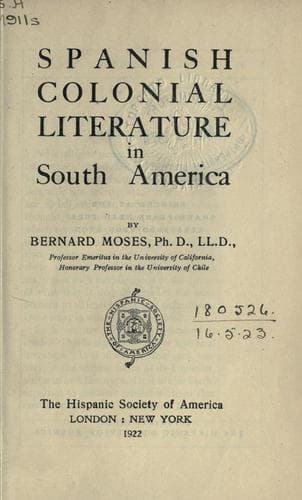
Spanish colonial literature in South AmericaMoses, Bernard
History
Spanish colonial literature in South America
Moses, Bernard
Spanish American literature -- History and criticism
Cobo had prepared himself for his somewhat ambitious undertaking by his
studies at the Jesuit college at Lima, by keeping in mind his plan for
many years, and by persistent and systematic observations and inquiries
during his many and extensive journeys. He was born in Lopero, a town of
Jaén in Spain, in 1582. He left Spain for America in 1596. He was carried
away on the current of emigration, moved by the desire for adventure and
wealth that set strongly towards Peru in the last half of the sixteenth
century. He visited the Antilles and Venezuela, and arrived at Lima in
the beginning of 1599. Through the influence of a Jesuit whom he met on
the voyage from Panama to Callao, he obtained a scholarship, and entered
the college of San Martín. Fifteen years later, in 1615, having been
admitted to the Society, he was sent to Juli, and for three years was
engaged in missionary work at Potosí, Cochabamba and La Paz. From 1618
to 1621 he was rector of the college at Arequipa, and afterwards, for
five years, resided at the house of the Jesuits in Pisco. From 1627 to
1630 he was the rector of the college at Callao; but at the end of this
service he was sent to Mexico, where he remained for twenty years. At a
date not known with certainty he returned to Lima, and died there on the
9th of October, 1657, at the age of seventy-five. During the sixty-one
years of his residence in America he gathered the detailed information
that was embodied in his _Historia_, which, with the exception of the
fragments already mentioned, remained in manuscript two hundred and fifty
years.[126]
In the seventh chapter of the _Historia de Lima_ Cobo gives a glimpse of
the valley of the Rimac as it appeared to him about a hundred years after
the conquest:
[Sidenote: Valley of the Rimac]
“The river of Lima is the larger, the other is called Caraguayllo, and
rises in the province of Canta, in the general cordillera, about twenty
leagues from the sea, into which it empties two leagues from the mouth
of the river of Lima. The irrigating ditches that lead out from these
two rivers are innumerable; they are distributed throughout the valley;
some are so big at their beginnings that they appear to be rivers of
considerable volume, which draw their water from the river of Lima; we
call them ditches of Surco, because they lead to a town of that name, the
lands of which they irrigate, as well as those of three other towns, and
altogether more than forty estates, or ranches, of Spaniards, residents
of this city, and there is among them an estate comprising two leagues of
land.
[Sidenote: The fair prospect of the Rimac valley]
Public-domain text, read in full here on John Shaqi.
Reviews
Reviews
No reviews yet
Be the first to share your thoughts on this work.
Elsewhere in the archive
Join the Discussion
Join the discussion
Sign in to leave a comment or review.
Sign InorCreate an account