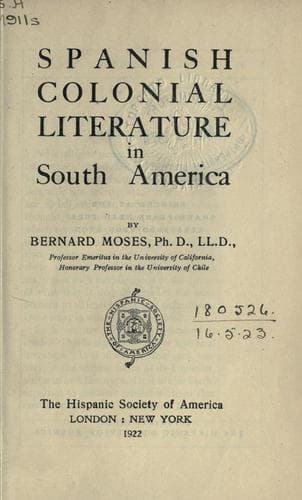
Spanish colonial literature in South AmericaMoses, Bernard
History
Spanish colonial literature in South America
Moses, Bernard
Spanish American literature -- History and criticism
“Through the efficiency of these canals, or ditches, which develop
and fertilize the country, it is at all times green, pleasant, and
delightful, offering to the view a fresh and serene spring; and all the
country estates have houses whither the residents of Lima were accustomed
to go for recreation (without misgivings lest rain might disturb their
fiestas and pleasures, for it never rains); they add greatly to the
beauty of the valley; especially are very marked the freshness and
verdure, which the olive trees, the plantains, and the cane fields give
to it. The innumerable gardens of fruit trees, such as orange, quince,
pomegranate and fig; vineyards and orchards with all kinds of the fruits
of the country and of Spain; the palms from afar seem to dominate the
other trees; and the alfalfa fields with their perpetual and luxuriant
freshness beautify all the environs of the city. They are so extensive
that they occupy a good part of this level region, for the alfalfa is
the common fodder of the horses and other work animals of the city and
country, so that this city has very agreeable surroundings on all sides.”
VII
[Sidenote: Classes of Jesuit writings]
[Sidenote: _Cartas anuas_; _varones ilustres_]
The most numerous of the Jesuit writings were the _Cartas anuas_, or
reports from the several districts concerning the work of the Jesuits
and the most important general events of the period covered; the _Vidas
de varones ilustres_, or the lives of distinguished Jesuits; and
_Cartas de edificación_. Padre Alonso Mesía Venegas’ _Historia de los
varones insignes de la provincia del Perú de la Compañía de Jesús_ is a
conspicuous instance of the writings of the second class. The author was
born in Seville in 1557; went to Peru with the family of Count Villar,
the viceroy, in 1585; was educated under Jesuit influence and entered
the order; became the procurador of Peru; and subsequently was appointed
the rector of the college in Cuzco. In the execution of his duties as
procurador he went to Rome and Madrid and on his return to America served
as rector of the college at Potosí. It was Venegas who carried to Europe
samples of quina, which had already been administered with beneficial
results to the Condesa de Chinchón, wife of the viceroy.
[Sidenote: Venegas suspected and banished]
For a period of three years, from 1637 to 1640, Venegas was established
at the college of San Pablo. Viceroy Mancera suspected him of being the
author of certain reports sent to Spain, describing acts of the viceroy
as arbitrary and unjust, and expelled him from Peru. A year later, the
really guilty person having been discovered, the order of expulsion was
revoked. Venegas then returned to the college of San Pablo, where he died
October 17, 1649.
[Sidenote: Juan de Urquiza]
Public-domain text, read in full here on John Shaqi.
Reviews
Reviews
No reviews yet
Be the first to share your thoughts on this work.
Elsewhere in the archive
Join the Discussion
Join the discussion
Sign in to leave a comment or review.
Sign InorCreate an account