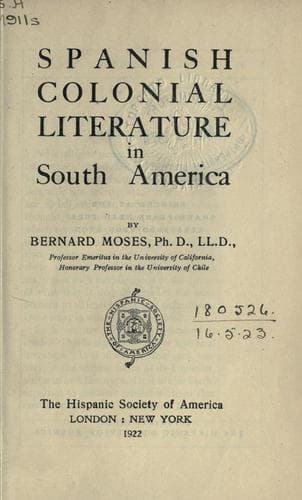
Spanish colonial literature in South AmericaMoses, Bernard
History
Spanish colonial literature in South America
Moses, Bernard
Spanish American literature -- History and criticism
Out of the experience of this voyage there came to Quiros the vision of
a great antarctic continent stretching across the southern part of the
earth from America to Asia. By proving to the world the existence of
this continent he hoped to obtain for himself a place with Columbus and
Da Gama in the list of the great discoverers. To acquire the means that
would enable him to carry out his proposed undertaking he visited the
viceroy in Lima, presented his project to the pope at Rome, and from
Clement VIII and the duke Sesa he received letters recommending him to
the Spanish government. In spite of the demoralization of the the court
and the rapid decline of the government towards bankruptcy there remained
still the hope of adding to the glory that Columbus had conferred upon
the nation; and through the council of State the king issued an order to
the viceroy of Peru instructing him to fit out two ships at Callao to
enable Quiros to undertake a voyage for the discovery of the antarctic
continent. The inevitable delays followed. Finally two ships were
prepared, and in December, 1605, Quiros was ready to set sail to realize
the object of his vision. A narrative of this voyage is found in the
_Historia_ edited by Zaragoza.[135]
Quiros’ return, his disappointment, the poverty of his later years, and
his many vain appeals to the king for further assistance are incidents
in the melancholy ending of a great visionary.
[Sidenote: Pedro Gobeo de Victoria]
The _Naufragio y viaje en las costas del Perú_, by Padre Pedro Gobeo de
Victoria, was one of the more widely circulated narratives of personal
adventure. The author, whose experience furnished abundant material for
his story, was born in Seville in 1560. He went to America at the age of
thirteen and during his journeys was at various times engaged in combats
with pirates, suffered shipwreck, and encountered about all the other
perils known to land or sea. After many years of a troubled existence, he
entered the order of the Jesuits at Lima in 1597. For thirteen years he
enjoyed a comparatively peaceful existence. He returned to Spain in 1610.
He died at Seville at the age of seventy. His book has been translated
into various languages. A Latin translation was published in 1647, of
which a new edition was issued in 1688. The first edition in Spanish
appeared in 1610.[136]
Public-domain text, read in full here on John Shaqi.
Reviews
Reviews
No reviews yet
Be the first to share your thoughts on this work.
Elsewhere in the archive
Join the Discussion
Join the discussion
Sign in to leave a comment or review.
Sign InorCreate an account