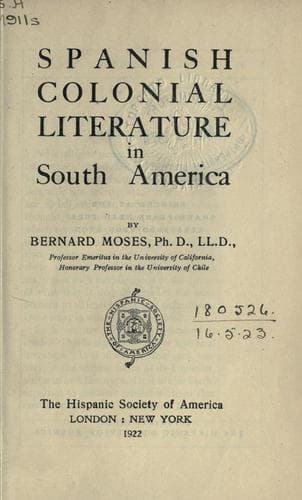
Spanish colonial literature in South AmericaMoses, Bernard
History
Spanish colonial literature in South America
Moses, Bernard
Spanish American literature -- History and criticism
In the middle of the nineteenth century Odriozola published a collection
of verses written by Juan del Valle y Caviedes in the last part of the
seventeenth century. The author was born in Lima, and was the son of a
rich Spanish merchant. At the age of twenty he went to Spain, where he
remained three years, and at the expiration of this period the death of
his father obliged him to return to Lima. Finding himself in possession
of a considerable fortune, he entered upon a career of vicious and
extravagant expenditure, wasting a large part of his inheritance and
greatly impairing his health. After a severe illness he determined to
reform his mode of life, married, and, in order to preserve the remainder
of his property, he opened a shop for the sale of a thousand and one
common and cheap articles. The death of his wife made him feel the need
of consolation, and he sought it in alcoholic drink, by which he found
oblivion of his sorrow in death in 1692, before he had completed his
fortieth year.
[Sidenote: Valle y Caviedes’ poems]
His poems, extensively circulated in manuscript during his life, made
him widely known, but in the course of the century and a half following
his death he passed very largely out of the public memory. The two
collections of these poems published by Odriozola were called _Diente
del Parnaso_ and _Poesías serias y jocosas_. In an introduction to
these poems as published, Ricardo Palma wrote: “Caviedes was a most
unfortunate poet. Many times I have encountered his verses in periodicals
of Peru or of foreign countries, either anonymous or signed by some
vagabond, but never have I found under them the signature of the true
author. In life Caviedes was the victim of quacks; and in death the
victim of literary pirates.”
[Sidenote: On medical science in Peru]
The low state of medical science in Peru in the last half of the
seventeenth century called forth from Caviedes numerous critical and
satirical references to the ignorance and lamentable practice of Peruvian
physicians. Viceroy Liñán y Cisneros (1679-1681), in his account of the
state of the viceroyalty, made for his successor, the duke of Palata,
refers to the miserable state of medical science and practice in Peru,
the lack of revenue and the consequent abandonment of instruction in
medicine, and the exposure of the health of the population to the mercy
of pretentious ignorance. Gutiérrez wrote of Caviedes that he “had no
convictions acquired by study hostile to the uncertainties of the science
of medicine. He knew by observation that the disciples of Hippocrates
kill when they make mistakes, and the instinct of preservation and love
of life put terrible arms into his hands, against those who, in his view,
had once brought him to the brink of the grave. His vengeance was cruel.
Ill-will served him as a muse, and it cannot be denied that in many of
his compositions there was manifest true inspiration.”[138]
II
[Sidenote: Sons of nobles sent to Peru]
Public-domain text, read in full here on John Shaqi.
Reviews
Reviews
No reviews yet
Be the first to share your thoughts on this work.
Elsewhere in the archive
Join the Discussion
Join the discussion
Sign in to leave a comment or review.
Sign InorCreate an account