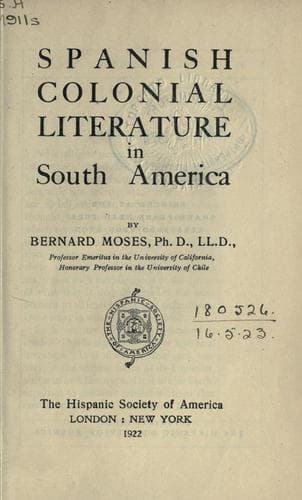
Spanish colonial literature in South AmericaMoses, Bernard
History
Spanish colonial literature in South America
Moses, Bernard
Spanish American literature -- History and criticism
In spite of the wealth which the New World had poured into Spain many
of the noble families were poor in the seventeenth century, and some
of these found it difficult to give their sons such an education as
their talents and station demanded. Frequently young persons of this
class secured positions as pages in the viceroy’s household, and were
educated under his supervision, sometimes remaining in Peru and acquiring
distinction in the affairs of the state or the Church. Some of them with
the viceroy’s approval joined religious orders. Ignacio de Arbieto is an
instance of one who became a Jesuit.
[Sidenote: Arbieto’s life and writings]
He was born in Madrid in 1585. At Lima he studied in the college of San
Pablo, later taught Latin in the same institution, became professor of
philosophy at Quito, was transferred to the college in Arequipa, where
he became rector of the institution, returned to the college of San
Pablo in Lima as professor of theology, was appointed rector of the
college at Chuquisaca, and subsequently took up his duties as rector of
the college of San Martín in Lima. After long service as professor and
rector of various colleges of the Society, he died in Lima on August 7,
1676. During his last years he served as counsellor of the provincial,
and at the same time was occupied in writing his _Historia del Perú y de
las fundaciones que ha hecho en él la Compañía de Jesús_. A _Suma de las
obras teológicas del P. Francisco Suárez_ is attributed to Padre Arbieto.
[Sidenote: Arbieto’s successor]
[Sidenote: Barrasa’s _Historia de las fundaciones_]
The failure of Arbieto’s work to receive the approval of the General
of the Society led to the demand that another person should be charged
with writing the history of the Jesuit foundations. By vote of the
provincial congregation of 1674 Padre Jacinto Barrasa was appointed to
undertake the task, which he completed in a manuscript volume of 1350
pages to the satisfaction of the authorities; but this appears not
to have been published. The book was more exclusively devoted to the
affairs of the Jesuits than were most of the writings of the Jesuit
historians. He treated neither of the political history of the country
nor of its geography, affirming that these phases of the subject had
been sufficiently presented by Calancha in his _Crónica moralizada_.
His course with respect to the second subject was altogether unusual,
for from the beginning even to the present geographical description has
been a conspicuous feature of South American writings. The real theme
of Barrasa’s book is sufficiently set forth in its title: _Historia de
las fundaciones de los colegios y casas de la provincia del Perú de la
Compañía de Jesús, con la noticia de las vidas y virtudes religiosas de
algunos varones ilustres que en ella trabajaron_.
Public-domain text, read in full here on John Shaqi.
Reviews
Reviews
No reviews yet
Be the first to share your thoughts on this work.
Elsewhere in the archive
Join the Discussion
Join the discussion
Sign in to leave a comment or review.
Sign InorCreate an account