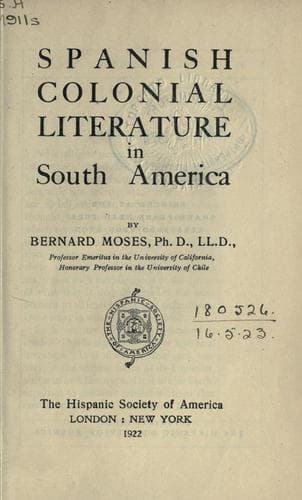
Spanish colonial literature in South AmericaMoses, Bernard
History
Spanish colonial literature in South America
Moses, Bernard
Spanish American literature -- History and criticism
In 1643 rumours ran through the western colonies that the Dutch were
preparing to invade Chile. The prospect of this invasion induced the
viceroy of Peru to send a body of three hundred soldiers to strengthen
the military forces already in the southern colony. Jerónimo de Quiroga,
then a youth of eighteen, was a member of this company, and arrived
in Chile near the end of the year. He apparently remained there in
the service, for a few years later, at the age of thirty-three, he
married a young woman of a prominent family of Santiago, and not long
afterwards he was advanced to the rank of captain of cavalry. During
the next thirty-five or forty years he rendered important services to
the state in both military and civil undertakings. One of his military
commissions was the taking of three thousand arms from Mendoza over the
Andes to Concepción. He was a life member of the ayuntamiento of Santiago
by royal confirmation. He had general charge of the construction of
the cathedral for a period, and contributed largely towards the work
from his own funds. He directed the fortification of Valparaiso and
Concepción, and repaired the more or less ruined fortifications of the
southern frontier.[140] He held various military commands, particularly
that of chief of the militia of Chile for a period of seventeen years,
and the governor turned to him for a method of reducing the Indians
of the frontier to civilization. At the close of his military career,
during which, especially in the later years, he encountered opposition
and intrigue, at the age of seventy he turned to the task of writing the
history of his country down to the events of his own time. His life in
Chile had covered a considerable part of this period, and for this reason
his book was properly called _Memoria de las cosas de Chile_. Medina
reports that only an extract of the first part has been preserved, and
that this was published in the twenty-third volume of the _Semanario
erudito_ of Madrid in 1788. This extract was called _Compendio histórico
de los más principales sucesos de la conquista y guerras del reino de
Chile hasta el año de 1656_. The critical judgment respecting Quiroga’s
style—his rapidity of narration, conciseness of expression, and the
harmony and facility of his phrases—indicates the degree of loss suffered
in the disappearance of the complete work.[141]
[Sidenote: Anello Oliva’s _Varones ilustres_]
Public-domain text, read in full here on John Shaqi.
Reviews
Reviews
No reviews yet
Be the first to share your thoughts on this work.
Elsewhere in the archive
Join the Discussion
Join the discussion
Sign in to leave a comment or review.
Sign InorCreate an account