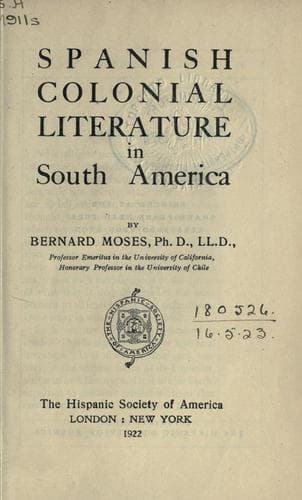
Spanish colonial literature in South AmericaMoses, Bernard
History
Spanish colonial literature in South America
Moses, Bernard
Spanish American literature -- History and criticism
Of Padre Anello Oliva little appears to be known aside from the fact that
he was born in Naples and became a member of the Society of Jesus. His
principal work is entitled _Vidas de varones ilustres de la Compañía de
Jesús de la provincia del Perú_. The sub-title describes the contents
more fully, announcing that the first of the four books treats of the
kingdom and provinces of Peru, the Incas, the discovery and conquest
by the Spaniards; and that the three other books describe the lives of
the Jesuits written, as one critic informs us, solely with the object
of preserving the memory of the Jesuits the most distinguished in the
virtues and in the observation of the rules of the Society, in order
that they might serve as examples to their successors; but offering no
interest to the historian, since they are limited, for the most part, to
referring to the manner in which these distinguished Jesuits succeeded in
reaching a high degree of perfection, and to eulogizing the merit which
they attained.[142]
[Sidenote: _Histoire du Pérou_]
In 1857 M. Ternaux Compans published the first book of Oliva’s _Vidas_
in a French translation made from the unpublished manuscript, under the
title, _Histoire du Pérou_. This book of Oliva’s work forms in some
sense an introduction to the lives of illustrious men. The persons whose
biographies made up the body of the work were Ruiz Portillo, José Acosta,
Baltasar Piñas, Juan Sebastián, Rodrigo de Cabrevo, Juan de Atienza,
Estevan Páez, Juan de Frías Herrán, Gonzalo de Lyra, and Juan Romero. The
first book was printed in Lima from the original Spanish manuscript in
1895.
[Sidenote: Grandezas de Lima]
[Sidenote: Ojeda’s opinions]
Long and dull years of isolation in the dependencies and ignorance of
the conditions of the older countries led the colonists to exaggerate
or overestimate what they saw in the cities of South America. If
they celebrated the accession of a king of Spain, it seemed to them
that nowhere else had there been seen such magnificence. In writing,
therefore, of the capital of Peru, Diego Ojeda Gallinato very naturally
entitled his book _Grandezas de Lima_. This book, Mendiburu says, is
extremely rare even in Spain, and that he had not been able to obtain
a copy of it. But other writers who had used it give some notions of
Ojeda’s opinions, particularly of the inhabitants of Peru, who appeared
to him, especially those descended from Spanish ancestors, discreet,
liberal, energetic, and possessed of most active minds; and what most
excited admiration was to see how early intelligence dawned in the
children.[143]
[Sidenote: Velasco’s _Arte de sermones_]
Public-domain text, read in full here on John Shaqi.
Reviews
Reviews
No reviews yet
Be the first to share your thoughts on this work.
Elsewhere in the archive
Join the Discussion
Join the discussion
Sign in to leave a comment or review.
Sign InorCreate an account