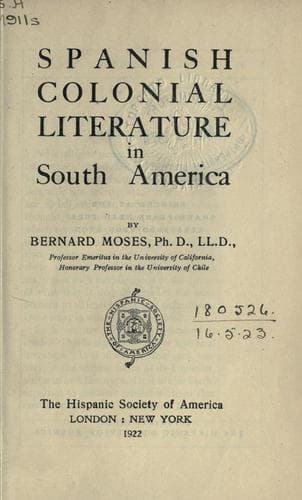
Spanish colonial literature in South AmericaMoses, Bernard
History
Spanish colonial literature in South America
Moses, Bernard
Spanish American literature -- History and criticism
The numerous paragraphs relating to ecclesiastical affairs point to the
conspicuous place held by the events connected with the Church. The
following quotation illustrates the style, in so far as the chronicle may
be said to have any style, and also the avaricious disposition of certain
colonial priests in administering the services of the Church.
[Sidenote: Priest Maturana’s exactions]
“Gaspar de Lagos, of the hospital parish, having died, the priest of the
parish demanded five hundred dollars for the funeral service, and finally
agreed to receive one hundred and eighty dollars. The widow of the
deceased went, on the 30th of December (1743), at eight o’clock in the
evening to Bishop Morcello, and showed him that it was impossible for her
to pay this amount. The bishop decided that the interment in accordance
with the widow’s wishes to be just, and, fixing the payment at sixty-one
dollars, handed to the widow a paper stating this decision. Then, the
widow went to the priest, Julián Maturana, and gave him the paper. The
priest threw the paper on the floor and stamped on it, and said that the
cross would not go out if she did not bring the one hundred and eighty
dollars. The widow returned to the bishop, now after nine o’clock at
night, and he ordered that they should bring the priest. The fiscal and
the officer sought for him in the house of the bishop of Panama, where he
was living, but they did not find him. The bishop then issued an order
that the Franciscan fathers should conduct the burial properly as the
widow required, and also ordered that the sixty-one dollars should be
applied to the work of the cathedral.”[150]
VII
[Sidenote: Rodríguez’ _El Marañón y Amazonas_]
The book by Padre Manuel Rodríguez entitled _El Marañón y Amazonas_ and
published in 1684 is a history of the discovery and reduction of the
tribes that lived in the region of the great rivers. It undertook to
set forth the praiseworthy as well as the unfortunate conduct of the
conquistadores respecting temporal and spiritual matters, and in six
books to present the data that had been acquired and the narratives that
had been written concerning the discovery of the Amazon; the services the
Jesuits had rendered and the missions they had founded; the progress
made in the government of Mainas from its establishment by Diego Vaca de
Vega; the journey of Captain Texeira to Quito and his return to Pará;
the sources of the rivers and their union with the Amazon; the labours
of missionaries and the tragic end of many of them; and an account of
Acuña’s report. This work may still be considered as an historical
document of value, and, barring its prolixity, a common failing of the
age, is not without literary merit.[151]
[Sidenote: Padre Samuel Fritz]
Public-domain text, read in full here on John Shaqi.
Reviews
Reviews
No reviews yet
Be the first to share your thoughts on this work.
Elsewhere in the archive
Join the Discussion
Join the discussion
Sign in to leave a comment or review.
Sign InorCreate an account