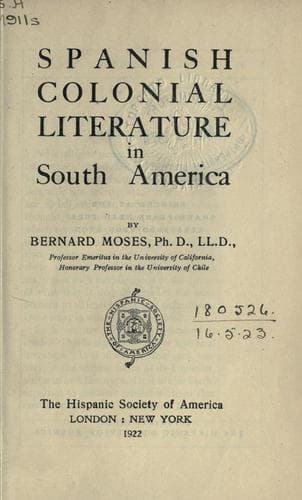
Spanish colonial literature in South AmericaMoses, Bernard
History
Spanish colonial literature in South America
Moses, Bernard
Spanish American literature -- History and criticism
Padre Claver[146] spent forty years of a devoted life in efforts to
relieve this misery,[147] and the story of this devotion was written by
Alonso de Andrade.[148] A more extensive account of Claver’s life by José
Fernández appeared in 1666. Another book relating to Cartagena is Luis
Jodar’s _Vida de la Venerable Madre Catalina María de la Concepción,
fundadora del Convento de Santa Clara de Cartagena_.
[Sidenote: Flórez de Ocáriz’s _Genealogías_]
The _Genealogías del nuevo reino de Granada_, by Juan Flórez de Ocáriz,
is a curious monument of patient labour and mediæval ignorance,
produced rather by manual labour than by intellectual effort. It fairly
exemplifies the tradition and vices of early, and perhaps of some later,
writings on genealogy, in pretending to establish a family connexion
between persons of similar names, who lived in widely separated ages
and in different parts of the world. But the introduction which takes
up about half of the first volume contains important information on
the local history of New Granada. An incentive to genealogical inquiry
was furnished by the ambition of many creoles to magnify the social
importance of their families. Two volumes of this work were published in
Madrid in 1674-76; a third remains unpublished.
[Sidenote: León y Bezerra]
A contemporary account of the events at Panama at the time of Morgan’s
invasion (1670) was written by Bishop Antonio de León y Bezerra, who,
having refused the office of Bishop of Panama three times, finally
accepted it in 1672. The following year, after the death of the conde
de Lemos the audiencia of Lima appointed Bishop León governor and
captain-general of Tierra Firme, and in January, 1674, he assumed the
duties of that office. In 1676, he was promoted to the post of Bishop
of Trujillo, and a little later was transferred to the bishopric of
Arequipa. He died in 1708.
VI
[Sidenote: _Anales del Cuzco_]
[Sidenote: Palma’s criticism]
An important source of detailed information concerning Peruvian history,
particularly the history of Cuzco, is the anonymous chronicle entitled
_Anales del Cuzco_ constituting four hundred and thirty-four pages of
a volume edited by Ricardo Palma, and published in Lima in 1901. It
covers a period of one hundred and fifty years, from 1600 to 1750.
Although lacking the attractive style of Calancha and some of the other
early writers, it nevertheless throws much light on many obscure points
of local history. Ricardo Palma attributes to the writer “a certain
independence of character and a standard of criticism not usual at that
time,” and cites as an illustration the author’s condemnation of the
extraordinary means employed by the preachers to terrify the Indians,
such as frightful pictures of the devil and graphic representations of
the sufferings of the damned in hell.[149]
Public-domain text, read in full here on John Shaqi.
Reviews
Reviews
No reviews yet
Be the first to share your thoughts on this work.
Elsewhere in the archive
Join the Discussion
Join the discussion
Sign in to leave a comment or review.
Sign InorCreate an account