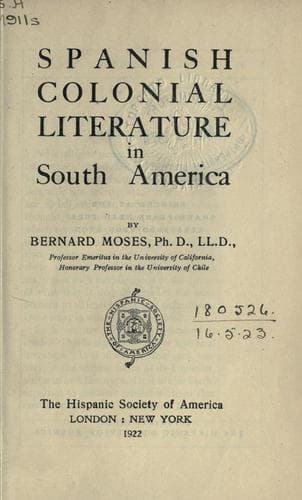
Spanish colonial literature in South AmericaMoses, Bernard
History
Spanish colonial literature in South America
Moses, Bernard
Spanish American literature -- History and criticism
The former is an extensive report designed for the instruction of the
king. It was not generally known until it was published in London by
David Barry in 1826. It is the most frank and searching examination
of the affairs of the colonies that has come down from the colonial
period. It presents the abuses of the courts, the civil employees, the
corregidores, and the clergy. It treats, moreover, of the contraband
trade, the frauds that appeared in the various branches of the
administration, the scandalous acts of the officials, and the oppression
and cruelty of the Spaniards in their dealing with the Indians. It
describes the state of the ports and the lack of arms and of other means
for defending the coast against invaders, and sets forth the increasing
hostility between the Spaniards and the creoles. It makes exceedingly
damaging specifications as to the treatment which the Indians received at
the hands of the corregidores, the manufacturers, and the priests. The
following passages from the _Noticias secretas_ illustrate this subject:
“It was ordered that the corregidores might introduce a quantity of such
articles as were suited to the needs of the Indians and distribute these
articles among them at moderate prices, in order that, having implements
for labour, they might shake off the apathy which is innate in their
constitution, and make the exertion requisite for paying their tribute
and supporting themselves.
[Sidenote: Distribution by Corregidores]
“The articles of distribution are chiefly mules, foreign and domestic
goods, and produce. The corregidores who are attached to the viceroyalty
of Lima must necessarily go to that city to take out a licence and to
receive their despatch from the viceroy in order to be inducted into
office; and as Lima is the principal depôt of the trade of Peru, it is
in that city that an assortment of articles for distribution is to be
made, and for this purpose they take the goods required from the shop of
some merchant or trader on credit, at an exorbitant price; for, as the
traders are aware of the enormous profits the corregidores make in the
sale, they raise the prices of the goods in order to have a share in the
speculation. The corregidores have no money before they come into office,
and, being unable to purchase for cash, they are obliged to submit to
any terms which the creditor may prescribe, since they are under great
obligations, on account of the money which the merchant is to lend them
for the purchase of the mules required for transportation.
[Sidenote: Corregidor’s wares]
[Sidenote: Despair of the Indians]
Public-domain text, read in full here on John Shaqi.
Reviews
Reviews
No reviews yet
Be the first to share your thoughts on this work.
Elsewhere in the archive
Join the Discussion
Join the discussion
Sign in to leave a comment or review.
Sign InorCreate an account