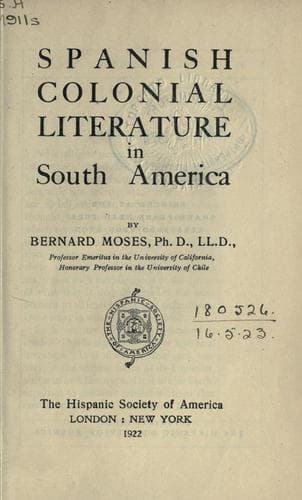
Spanish colonial literature in South AmericaMoses, Bernard
History
Spanish colonial literature in South America
Moses, Bernard
Spanish American literature -- History and criticism
“As soon as the corregidor comes within his jurisdiction, the first
act of his administration is to take a census of the Indians according
to their towns and villages. Proceeding to this duty in person, and
taking with him the articles of merchandise to be distributed, he goes
on, apportioning the quantity and kind he selects for every Indian,
and affixing to each article its price, just as suits his caprice, the
poor Indians being wholly ignorant of what is to fall to their lot, or
how much it is to cost them. As soon as he has finished distributing in
one village, he transfers the whole assortment to the cacique, with an
exact inventory of the articles belonging to each individual, from the
cacique himself to the most humble of all those who are to pay tribute;
and the corregidor proceeds to another village in order to continue
the distribution. It is a time of anguish both for the cacique and the
Indians, when they look at the quantity, quality, and prices of these
goods. In vain does the cacique remonstrate, and to no purpose do the
Indians raise their clamours; on the one hand, they maintain that their
means are not adequate to such a quantity of merchandise as is assigned
to them, being absolutely unable to pay for it; again, they urge that
goods of such a description are utterly useless to them, and that the
price is so exorbitant as to exceed anything they had ever paid before.
The corregidor remains inexorable and the Indians are obliged to take
whatever has been allotted to them, however repugnant it may be to their
wishes, and however straitened they are for want of means to make the
payments; for these payments become due simultaneously with the tribute
money, and the same penalty is imposed for failure to meet one as the
other. All the payments of the first distribution must be made within
two years and a half, to make way for the second, which usually does not
contain so many wares as the first” (p. 240).
The statement concerning the textile works is equally positive:
“In former years woollen manufacture was confined to the province of
Quito; but it has been recently introduced into other districts, although
the articles manufactured in the provinces south of Quito are nothing
but coarse cloths of very ordinary texture. In Cajamarca there are looms
for the manufacture of cotton goods....
[Sidenote: Indians in the obrajes]
[Sidenote: Punishment of the Indians]
Public-domain text, read in full here on John Shaqi.
Reviews
Reviews
No reviews yet
Be the first to share your thoughts on this work.
Elsewhere in the archive
Join the Discussion
Join the discussion
Sign in to leave a comment or review.
Sign InorCreate an account