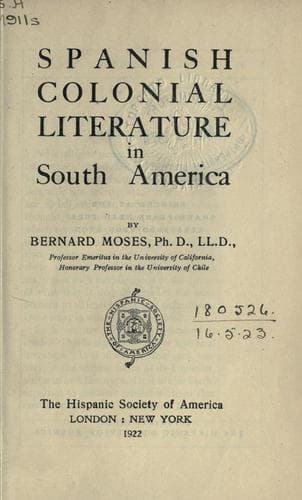
Spanish colonial literature in South AmericaMoses, Bernard
History
Spanish colonial literature in South America
Moses, Bernard
Spanish American literature -- History and criticism
In the course of his public career Ulloa rose to the rank of
lieutenant-general. He was born in Seville in 1716. His studies prepared
him for the position of an officer in the navy, and when Philip V granted
the request of Louis XV to be permitted to send a body of scientists to
measure an arc of the meridian under the equator in Ecuador, Antonio
de Ulloa and Jorge Juan were appointed to join the commission. Ulloa
gained distinction by his scientific investigations, and became a member
of the scientific societies of London, Paris, Berlin, and Stockholm.
From time to time he was charged with various official duties by the
government of Spain, and in 1763, when Louisiana was ceded to Spain,
Ulloa was appointed to take possession of the country and organize its
administration, thus becoming its first Spanish governor.
[Illustration: Antonio de Ulloa]
[Sidenote: _Relación_ and _Noticias_]
The _Relación histórica_ is an excellent account of Spanish South America
as it was near the middle of the eighteenth century, by two men who,
although special commissioners appointed by the king, were apparently
more disposed to tell the truth than to please their royal master.
Designed for the general public, this work is less severe in tone than
the _Noticias secretas_, which was written for the instruction of the
king and his ministers. Here is a description of the fair at Porto Bello
from the _Relación histórica_.
[Sidenote: The fair of Porto Bello]
“The town of Porto Bello, so thinly inhabited, by reason of its noxious
air, the scarcity of provisions, and the barrenness of the soil, becomes,
at the time of the galleons, one of the most populous places in all South
America. Its situation on the isthmus, betwixt the south and the north
sea, the goodness of its harbour, and its small distance from Panama
have given it the preference for the rendezvous of the joint commerce of
Spain and Peru, at its fair.
“On advice being received at Carthagena, that the Peru fleet had unloaded
at Panama, the galleons made the best of their way to Porto Bello, in
order to avoid the distempers which have their source from idleness. The
concourse of people, on this occasion, is such, as to raise the rent of
lodging to an excessive degree; a middling chamber, with a closet, lets,
during the fair, for a thousand crowns, and some large houses, for four,
five or six thousand.
“The ships are no sooner moored in the harbour than the first work is to
erect, in the square, a tent made of the ship’s sails, for receiving the
cargo; at which the proprietors of the goods are present, in order to
find their bales, by the marks which distinguish them. These bales are
drawn on sledges to their respective places, by the crews of every ship,
and the money given them is proportionally divided.
[Sidenote: Arrival of gold from Perú]
Public-domain text, read in full here on John Shaqi.
Reviews
Reviews
No reviews yet
Be the first to share your thoughts on this work.
Elsewhere in the archive
Join the Discussion
Join the discussion
Sign in to leave a comment or review.
Sign InorCreate an account