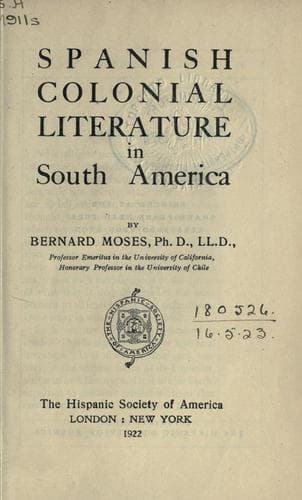
Spanish colonial literature in South AmericaMoses, Bernard
History
Spanish colonial literature in South America
Moses, Bernard
Spanish American literature -- History and criticism
“Whilst the seamen and European traders are thus employed, the land
is covered with droves of mules from Panama, each drove consisting of
above an hundred, loaded with chests of gold and silver, on account of
the merchants of Peru. Some unload them at the exchange, others in the
middle of the square; yet amidst the hurry and confusion of such crowds,
no theft, loss, or disturbance is ever known. He who has seen this place
during the tiempo muerto, or dead time, solitary, poor, and a perpetual
silence reigning everywhere, the harbour quite empty, and everyplace
wearing a melancholy aspect, must be filled with astonishment at the
sudden change, to see the bustling multitudes, every house crowded,
the square and the streets encumbered with bales and chests of gold,
and silver of all kinds; the harbour full of ships and vessels, some
bringing by way of Río de Chape, the goods of Peru, as cacao, quinquina,
or Jesuit’s bark, vicuña wool, and bezoar stones; others coming from
Carthagena, loaded with provisions; and thus a spot, at all other times
detested for its deleterious qualities becomes the staple of the riches
of the old and new world, and the scene of one of the most considerable
branches of commerce in the whole earth.
[Sidenote: Organization of the trading]
“The ships being unloaded, and the merchants of Peru, together with the
president of Panama, arrived, the fair comes under deliberation. And
for this purpose the deputies of the several parties, repair on board
the commodore of the galleons, where, in presence of the commodore, and
the president of Panama, the former as patron of the Europeans, and the
latter, of the Peruvians, the prices of the several kinds of merchandise
are settled; and all preliminaries being adjusted in three or four
meetings, the contracts are signed, and made public, that everyone may
conform himself to them in the sale of his effects. Thus all fraud is
precluded. The purchases and sales, as likewise the exchanges of money,
are transacted by brokers, embarking their chests of money, and those of
Peru, sending away the goods they have purchased in vessels called chatas
and bongos, up the river, Chagre; and thus the fair of Porto Bello ends.”
(Eng. tr. I, 101.)
II
[Sidenote: Alonso de Zamora]
[Sidenote: Character of Zamora’s book]
Public-domain text, read in full here on John Shaqi.
Reviews
Reviews
No reviews yet
Be the first to share your thoughts on this work.
Elsewhere in the archive
Join the Discussion
Join the discussion
Sign in to leave a comment or review.
Sign InorCreate an account