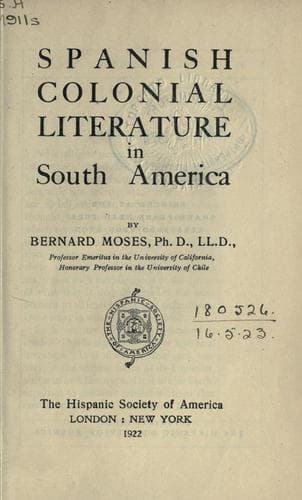
Spanish colonial literature in South AmericaMoses, Bernard
History
Spanish colonial literature in South America
Moses, Bernard
Spanish American literature -- History and criticism
The large majority of the men who have hitherto figured in the literary
history of New Granada have either been members of the religious orders
or functionaries of the Church in some other relation. In the person of
Francisca Josefa de Castillo y Guevara a nun appears, who, according to
Menéndez y Pelayo, “wrote in prose worthy of Santa Teresa.” She was born
in Bogotá on October 8, 1671, entered the convent of Santa Clara at Tunja
in 1689, and died there in 1742. She was afflicted with rickets, and
was an invalid from her childhood. In the convent she was encouraged by
her confessor to write her sentiments and reflections on her life. Her
papers sent to her confessor in obedience to his suggestion gradually
accumulated, and were later published in two more or less independent
works. These were _Vida de la venerable madre Francisca Josefa de la
Concepción, escrita por ella_, and _Sentimientos espirituales de la V.
M. Francisca Josefa_. Francisca’s early reading is said to have been
largely plays, but in the convent she read the writings of Santa Teresa.
Confined by her parents and by those persons who controlled her activity
to the limited education that was thought to be becoming a woman in
the Spanish colonies, her native intelligence enabled her to obtain a
profound insight into certain phases of life, and to acquire a style of
writing that persuaded the Colombian critic, Vergara, to declare that
“Madre Castillo is the most notable writer whom we possess; her style and
her language place her by the side of Santa Teresa.”[156]
[Illustration: Jorge Juan y Santacilla]
IV
[Sidenote: _Lima fundada_]
[Sidenote: Peralta’s writings]
In the “poema heroico” called _Lima fundada o conquista del Perú_, we
have an echo of the earlier historical narratives in verse. The author,
Pedro José de Peralta Barnuevo Rocha y Benavides, was born in Lima in
1663, and during a great part of a long life he was a member of the
University of San Marcos, at first as professor of mathematics. He was
rector of the university for the years 1715, 1716 and 1717. He served
as cosmographer from 1708 to 1748. He was a lawyer, directed an academy
which he had founded, was for many years engineer-in-chief of Peru, and
in this capacity planned and directed important works at the port of
Callao. For his great and varied learning Peralta’s contemporaries appear
to have held him in high esteem, and later opinion has confirmed their
view. The statement in Mendiburu’s _Diccionario histórico-biográfico del
Perú_ is that Peralta “was a master of six languages, and in the most
of them he wrote poetry correctly and in good taste; he was well versed
in sacred and profane history, was a profound mathematician, chemist,
botanist, and student in medicine; and his studies in jurisprudence
and canonical and theological matters he carried as far as the first
professors of his time.” (VI, 265.) The long list of his work, moreover,
suggests unusual capacity and attainments.[157]
Public-domain text, read in full here on John Shaqi.
Reviews
Reviews
No reviews yet
Be the first to share your thoughts on this work.
Elsewhere in the archive
Join the Discussion
Join the discussion
Sign in to leave a comment or review.
Sign InorCreate an account