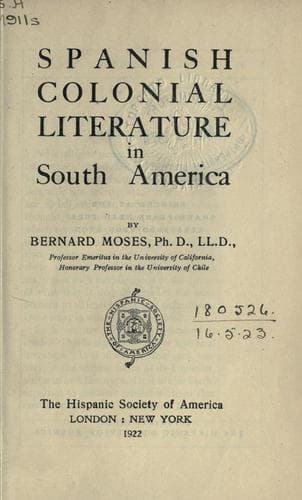
Spanish colonial literature in South AmericaMoses, Bernard
History
Spanish colonial literature in South America
Moses, Bernard
Spanish American literature -- History and criticism
[Sidenote: Quality of _Lima fundada_]
_Lima fundada_, in ten cantos embracing somewhat more than ten thousand
lines, treats of the conquest of Peru from Pizarro’s invasion to the
overthrow of Almagro. In order that the thought may seem to move on an
exalted plane, and the stanzas differentiate themselves from ordinary
prose, the statements of fact are often made vague and roundabout, and
the narration is abundantly sprinkled with intensifying adjectives.
The hero is always “the great Pizarro” or “the great marquis,” and
the soldiers are the “illustrious troops.” Large numbers of Grecian
mythological characters are drawn into the service; the names of Ulysses,
Alcibiades, Trajan and Socrates are woven familiarly into the lines; and
the impression is made that the author knew too much to be a successful
poet. Persons who seek for an elevated and inspiring form of genuine
poetry in these three hundred and eighty pages of verses will hardly find
it.
[Sidenote: _Armas antárticas_]
The twenty cantos of _Armas antárticas_ constitute a document that is
properly classed with _Lima fundada_. It was written by Juan de Mira.
Unless printed since my latest information concerning it, it is still in
manuscript in the National Library of Madrid. It was probably written in
Lima between 1612 and 1615, and the writer’s aim appears to have been to
prevent the deeds of the Spaniards in conquering, pacifying and defending
Peru from “remaining hidden in the darkness of forgetfulness.”[158]
The opening octave makes a general announcement of the author’s theme:
Las armas y proezas militares
De españoles católicos valientes,
Que por ignotos y soberbios mares
Fueron a dominar remotas gentes,
Poniendo al verbo eterno en los altares
De oráculos gentílicos, espanto
Eran del indio, ahora mudos, canto.[159]
[Sidenote: Gathering the ransom]
And the following lines describe the gathering of the gold for
Atahualpa’s ransom:
... al instante
Chasquis despacha el inca a diferentes
Partes, para quel oro rutilante
Traigan con brevedad todas sus gentes;
No hay noble, no hay cacique, no hay infante,
No hay niños, no hay mujeres, no hay sirvientes
Que así como las próvidas hormigas
No traigan a la sala sus espigas.[160]
V
[Sidenote: Missions of the Llanos]
Public-domain text, read in full here on John Shaqi.
Reviews
Reviews
No reviews yet
Be the first to share your thoughts on this work.
Elsewhere in the archive
Join the Discussion
Join the discussion
Sign in to leave a comment or review.
Sign InorCreate an account