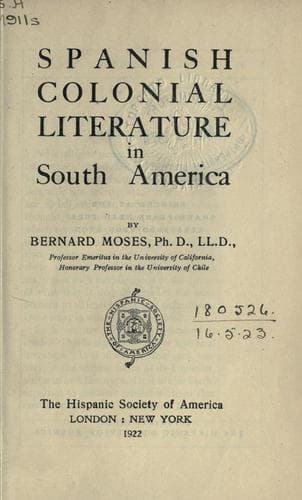
Spanish colonial literature in South AmericaMoses, Bernard
History
Spanish colonial literature in South America
Moses, Bernard
Spanish American literature -- History and criticism
“He also brought with him from Spain his commission from H.I. Majesty,
and required that Domingo Martínez de Irala should yield up the whole
government to him, and that all the men should be obedient to him in
every respect. The commander, Martínez de Irala, and all the people
declared they were ready to obey, but with this understanding, that he,
Cabeza de Vaca, should before show and lay before them documents to prove
that he had received from His Imperial Majesty such powers and authority.
“But this the whole assembly could not obtain from him; only the priests
and two or three of the captains affirmed it, that Alvar Núñez Cabeza de
Vaca ruled and commanded; but we shall see hereafter how things went with
him.
“Now, this said Alvar Núñez Cabeza de Vaca passed all the people in
review, and found that there were eight hundred men. At the same time he
made friendship with Martínez de Irala, and they became sworn brothers,
so that he, Martínez de Irala, was no less than before commander of the
people.”[166]
In another place Schmidel gives an account of the arrest and expulsion of
Governor Núñez Cabeza de Vaca:
[Sidenote: Governor’s arrest and expulsion]
“Thereupon it was resolved by all, nobleman and commoner, to meet in
council, with a view to take prisoner the chief commander, Alvar Núñez
Cabeza de Vaca, and to send him to H.I. Majesty, and to report to His
Majesty about his nice virtue, and how he had behaved towards us, and
how, according to his reason, he had governed; and other things besides.
“According to the resolution come to, these three gentlemen, namely,
the treasurer, or judge, the clerk, or master of the toll or custom,
and the secretary ordered by H.I. Majesty, whose names were Alonso
Cabrera, Francisco de Mendoza, García Vanegas, and Felipe Cáceres, taking
with them two hundred soldiers, went to his lodging, and arrested our
commander-in-chief, Alvar Núñez Cabeza de Vaca, when he least expected
it. And this happened on St. Mark’s Day, 1543. They held prisoner the
said Alvar Núñez Cabeza de Vaca for a whole year, until a ship called
a caravel, provided with victuals and a crew had been prepared. And
on board this ship the often-mentioned Cabeza de Vaca, with two other
officers on behalf of H.I. Majesty were conveyed to Spain.
[Sidenote: Irala’s election]
“After that we had to elect another who should rule and govern the
country until H.I. Majesty had time to designate one himself. And we
held it for good, as it was the meaning and the will of the community,
to nominate as chief Martínez de Irala, not only because he had formerly
governed the country, but especially because most of the soldiers were
satisfied with him.”[167]
II
[Sidenote: Knowledge of Jesuits in Paraguay]
[Sidenote: Letters from the padres]
[Sidenote: _Anuas_]
Public-domain text, read in full here on John Shaqi.
Reviews
Reviews
No reviews yet
Be the first to share your thoughts on this work.
Elsewhere in the archive
Join the Discussion
Join the discussion
Sign in to leave a comment or review.
Sign InorCreate an account