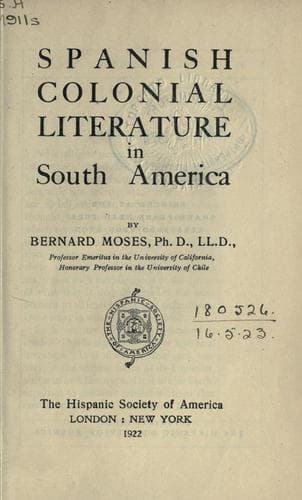
Spanish colonial literature in South AmericaMoses, Bernard
History
Spanish colonial literature in South America
Moses, Bernard
Spanish American literature -- History and criticism
The family of Schmidel has been known in Bavaria since 1364, and is said
to have been ennobled. The author’s father, Wolfgang Schmidel, was held
in high esteem by his townsmen, and was three times burgermeister of
Straubing. He died in 1511, leaving three sons, of whom the youngest,
Ulrich, was born in the first decade of the sixteenth century. Little
or nothing is known of his boyhood or youth. His narrative indicates
only a moderate degree of education. In 1534 he was at Antwerp, probably
sent thither as a commercial agent or dependant, and in that year he
enlisted as a soldier for service in the New World. At that time he was
probably about twenty-five years of age. The same year he arrived at
Cadiz, and departed for America with Mendoza’s expedition, destined for
the Río de la Plata, that had been discovered by Solís and explored by
Cabot. Mendoza’s fleet consisted of fourteen ships, having on board about
two thousand five hundred persons; of these one hundred and fifty were
soldiers. Two years after landing at the site of Buenos Aires a review of
the colony showed five hundred and sixty survivors; the greater part had
died of hunger. Schmidel witnessed the ravages of famine, the abandonment
of the settlement at Buenos Aires, the founding of Asunción; was with
Irala in the expedition towards Peru; served under Cabeza de Vaca, whom
he characterized as an adventurer and unfit for the enterprise in which
they were engaged; and took part in the rebellion of 1549. A letter
from his brother Thomas, who had held the inheritance from his father,
requested his return to Germany. His petition for a discharge was at
first refused, but was finally granted with favourable commendation for
the service he had rendered.[165]
[Illustration: Title page of the revised edition of Schmidel’s
“Warhafftige Historien,” Latin translation]
[Sidenote: Schmidel and affairs of Paraguay]
It has been denied that Schmidel was a soldier, but that view appears
hardly tenable in the face of his clear designation of himself as a
soldier. He was loyal to Irala, and took part in the revolt against the
governor. His relation to this undertaking sufficiently explains his
opinion of Núñez, and prepares one to find in his book a partisan account
of events in Paraguay during these troubled years. The following is
Schmidel’s reference to Alvar Núñez Cabeza de Vaca’s arrival in Asunción
after the overland journey from the Atlantic coast:
[Sidenote: Arrival of Núñez Cabeza de Vaca]
“This commander was eight whole months on his way, for the distance is
reckoned to be five hundred miles from Asunción to the place or harbour
of Santa Catalina.
Public-domain text, read in full here on John Shaqi.
Spanish colonial literature in South America — John Shaqi
Reviews
Reviews
No reviews yet
Be the first to share your thoughts on this work.
Elsewhere in the archive
Join the Discussion
Join the discussion
Sign in to leave a comment or review.
Sign InorCreate an account