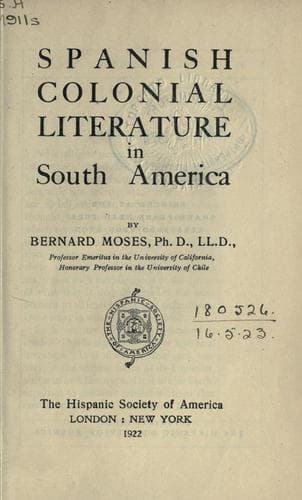
Spanish colonial literature in South AmericaMoses, Bernard
History
Spanish colonial literature in South America
Moses, Bernard
Spanish American literature -- History and criticism
“The provisions they brought being spent, there followed such a
terrible famine, that many fed upon man’s flesh, and things not to be
mentioned.... The cruelty of the barbarous people, the fear of wild
beasts, and the severity of the commanders suffered none to go out of
the works. Yet there was a woman, who weighing the misery of famine,
chose rather to expose herself to the inhumanity of the Indians and wild
beasts, than to suffer the torture of hunger; and therefore stealing out,
she wandered a long time about the fields, till at night she went into
a cave, where finding a lioness ready to whelp, she renewed her ancient
experience and had the boldness to play the midwife, much to her own
advantage, for the lioness laying aside her fierceness, fairly divided
her prey among her young ones and her midwife, till the latter fell into
the hands of the barbarians; and being after many accidents redeemed by
the Spaniards, was brought again to the fort. Being then condemned for
her rashness and disobedience, she was exposed without the works, to be
devoured by wild beasts, where she must have perished, had not God in His
providence so ordered it, that the lioness she helped to whelp, came up
to her first, and defended her innocent midwife against the rest.”[168]
[Sidenote: Andrés de León]
An early sketch of the south-eastern part of the Spanish possessions
was written by Andrés de León y Garabito, who was born in Lima, became
judge of the audiencia of Panama, and, in 1643, judge of the audiencia
of Charcas. Subsequently he was appointed governor of Paraguay. This
position he held until 1651, when he went to Buenos Aires as inspector of
the royal treasury in that province. He wrote of the origin, the defence,
the organization, and other particulars of that region.
III
[Sidenote: Pedro Lozano]
But the most prolific as well as the most trustworthy of the Jesuit
historians of Paraguay was the famous Pedro Lozano. It has been possible
to fix definite dates to but few events of his life. Very good reasons,
however, have been advanced to show that his boyhood was spent in
Madrid, and that he carried on his early studies there. As a youth, he
became a Jesuit, and arrived in America in the second decade of the
eighteenth century. In the New World he resided habitually at Córdoba,
in the Colegio Máximo and at the hacienda Santa Catalina; but he visited
Buenos Aires, the pampas, and the Andes; he examined the archives at
Santiago del Estero, Tucumán, and Salta; and the amount and quality of
his writings indicate that he could not have been much diverted from his
literary activity. Neither the date nor the place of his death has been
established beyond a question, but the evidence available points somewhat
clearly to the year 1752.
[Sidenote: _Descripción del Gran Chaco_]
Public-domain text, read in full here on John Shaqi.
Reviews
Reviews
No reviews yet
Be the first to share your thoughts on this work.
Elsewhere in the archive
Join the Discussion
Join the discussion
Sign in to leave a comment or review.
Sign InorCreate an account