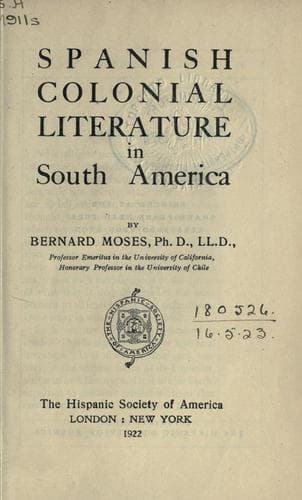
Spanish colonial literature in South AmericaMoses, Bernard
History
Spanish colonial literature in South America
Moses, Bernard
Spanish American literature -- History and criticism
[Illustration: Fr. GASPAR DE VILLARROEL.]
[Sidenote: Criticism in _Anales de la Biblioteca_]
[Sidenote: Guevara’s plagiarism]
The fifth volume of _Anales de la Biblioteca_ (Buenos Aires, 1908)
contains a new and complete edition of Guevara’s _Historia del Paraguay,
Río de la Plata y Tucumán_, superseding the incomplete copies issued by
Angelis and by Lamas. In the preliminary essay of this publication Paul
Groussac has subjected Guevara’s work to a severe critical examination,
in which he makes clear Guevara’s dependence on Lozano’s writings, not
merely the ordinary dependence of one writer on the results attained
by other investigators in the same field, but the dependence of the
plagiarist. The principal historical accounts of this south-eastern
part of America in existence before Guevara wrote were those of Techo,
Charlevoix, Lozano, and Centenera’s _Argentina_. Guevara’s dependence
goes so far that the whole substance of his book is found in Lozano,
except the final matter of the twelfth decade, which is drawn from Techo.
“The ordinary character of Guevara’s imitation consists in reproducing
more or less servilely the corresponding passage of Lozano. Especially
in the parts referring to the flora and fauna, the transcription, either
entire or fragmentary, is usually literal, without change of verb or
adjective. On the other hand, there are numerous suppressed passages,
arbitrary, brutal, really chopped out of the parts mutilated.” The
critic finds the copying not the chief offence, since it was a practice
generally observed in the Society, but the deceit of the preamble and
the author’s injurious silence respecting the historian to whom he owed
everything. But admitting that this severe judgment is well founded,
emphasis may be laid on the fact that Guevara’s style represents a
considerable advance over that of his predecessors in the same field. If
it may be regarded as consciously laboured, it certainly has the great
merit of clearness. The author does not give any indication of great
learning, or as in possession of an extensive variety of knowledge, but,
as Groussac suggests, he had nevertheless “sufficient attainments for the
satisfactory accomplishment of his task.”[170]
V
[Sidenote: Effect of Jesuit expulsion]
[Sidenote: Dobrizhoffer and Pauke]
Public-domain text, read in full here on John Shaqi.
Reviews
Reviews
No reviews yet
Be the first to share your thoughts on this work.
Elsewhere in the archive
Join the Discussion
Join the discussion
Sign in to leave a comment or review.
Sign InorCreate an account