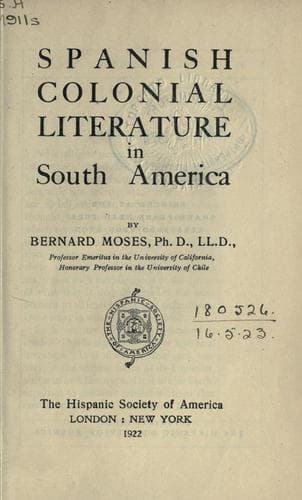
Spanish colonial literature in South AmericaMoses, Bernard
History
Spanish colonial literature in South America
Moses, Bernard
Spanish American literature -- History and criticism
Juan de Alloza studied at the Jesuit school in Lima, passed to the
university, entered the Society of Jesus, and became the most forceful
preacher of his time. In a sermon delivered on the occasion of the
festival of St. Paul, he commented on the bad example set by the
viceroy’s speech and acts. For this he was reprimanded by the superior
ecclesiastical authorities, and his right to preach was withdrawn. The
viceroy, informed of this action, ordered that Alloza should be permitted
to continue his preaching. “If Alloza,” he said, “does not tell us the
truth, who will tell us what especially concerns us? Let him continue
in the pulpit, and let the first sermon which he pronounces be preached
in my palace.” Acting on the suggestion of this episode, a preacher of
another order undertook to exercise a similar freedom of criticism,
but he was called to account, and the viceroy, on imposing the merited
punishment, bade him remember “que no todos eran Alloza.”[185]
[Sidenote: José Silva]
Padre José Silva’s life falls principally in the first half of the
eighteenth century. He was born in Lima in 1703, became a Jesuit in 1720,
and died two years after the edict of expulsion. He served many years as
a professor of philosophy, part of the time in the University of Cuzco.
Besides a treatise on the civil law in two volumes, he wrote extensively
on ecclesiastical subjects; on the evils of Calvinism; on the necessity
and the existence of a divine revelation; and on the eucharist.
[Sidenote: Francisco de la Cruz]
Francisco de la Cruz, a Dominican, was not less prolific than Alloza as a
writer on religious questions. He was born in Granada, studied in Lima,
made his profession of faith in the monastery of his order in Cuzco in
1616, and became a professor in the University of San Marcos. Entrusted
with various important ecclesiastical offices he finally attained the
dignity of a bishop, and was charged with relieving the Indians of Potosí
from the burdens imposed upon them by the miners. In executing this
commission he aroused the hostility of the Spaniards, whose interests
were affected. The mystical character of his writings is sufficiently
indicated by some of the titles of his books, such as _De la concepción
de María_ (Lima, 1653), _Historia del rosario a coros_ (Alcalá, 1652);
and _El jardín de María_ (Salamanca, 1655).
[Sidenote: Juan Cajica]
[Sidenote: The manuscripts of Cajica]
Public-domain text, read in full here on John Shaqi.
Reviews
Reviews
No reviews yet
Be the first to share your thoughts on this work.
Elsewhere in the archive
Join the Discussion
Join the discussion
Sign in to leave a comment or review.
Sign InorCreate an account