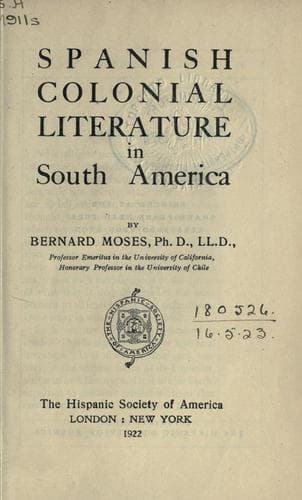
Spanish colonial literature in South AmericaMoses, Bernard
History
Spanish colonial literature in South America
Moses, Bernard
Spanish American literature -- History and criticism
Books like the _Semana espiritual con meditaciones del principio y fin
del hombre para cada día, y documentos de oración_, by Juan González
Gutiérrez (Madrid, 1656) and the numerous religious works of the friar
Andrés de San Nicolás have little significance except to illustrate the
prolific industry of certain ecclesiastical writers in the realm of
mysticism. San Nicolás’ _Historia general de los Agustinos Descalzos de
la Congregación de España e Indias_ (tomo I, Madrid, 1664), is, however,
accorded value as an account of the establishments of his order in Europe
and Asia, but it treats only briefly of the history of the order in
America. In spite of his voluminous writings San Nicolás appears to have
been little known in New Granada, and Vergara naively remarks that he
has considered this forgetfulness as a punishment inflicted by posterity
for the author’s lack of love for his country.[182]
[Sidenote: _El secular religioso_]
Another voluminous ecclesiastical writer of Bogotá was Juan Bautista
de Toro. The most important of his works is the big volume called
_El secular religioso_, published in Madrid in 1721, and republished
there in 1778. A feature of the work which the historian is bound
to consider is its denunciation of the injustice and greed of the
corregidores and the inhumanity of their treatment of the Indians.
In an article on _Curiosidades literarias_, Miguel Antonio Caro, in
_Repertorio colombiano_, calls attention to the fact that Toro wrote a
natural, simple and harmonious style at the time when “Gongorism with
the authority of the peninsular writers had passed to the Indies and
perverted completely the literary taste.”[183] The fact is also noted
that in spite of Toro’s constant eulogy of the Jesuits, and his energetic
condemnation of the conduct of Spanish officials in America, a second
edition of this book was issued from the royal press of Charles III.[184]
[Sidenote: Juan de Alloza]
In the seventeenth century mystical writings encountered fewer obstacles
to their publication, and were more extensively read in the Spanish
colonies than were books treating of purely secular subjects. The works
of Padre Juan de Alloza were chiefly of this kind. His _El breve oficio
del nombre de María_ was reprinted many times. His _El cielo estrellado
de María_ and his other books of a similar character found numerous
devoted readers. This was assured by the great reputation acquired by the
author in his lifetime. In gaining this reputation he had the advantage
of membership in an eminent colonial family. One of his brothers, who was
a priest at the cathedral, became rector of the University of San Marcos,
and died as bishop-elect of Santiago de Chile. Another brother in 1651
and in 1652 was also rector of the University, and an uncle, Gregorio de
Loaysa, was vicar-general of the archbishopric.
[Sidenote: No todos eran Alloza]
Public-domain text, read in full here on John Shaqi.
Reviews
Reviews
No reviews yet
Be the first to share your thoughts on this work.
Elsewhere in the archive
Join the Discussion
Join the discussion
Sign in to leave a comment or review.
Sign InorCreate an account