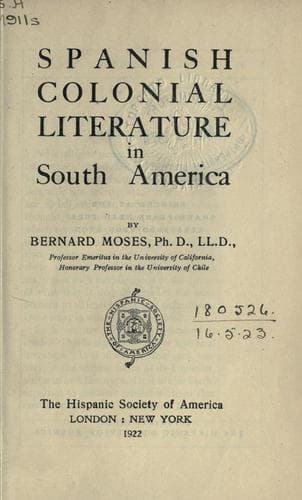
Spanish colonial literature in South AmericaMoses, Bernard
History
Spanish colonial literature in South America
Moses, Bernard
Spanish American literature -- History and criticism
Fernando de Vergara Azcárate and his brother José de Vergara Azcárate,
added materially to the mass of ecclesiastical writings of the first half
of the eighteenth century. They were both natives of Bogotá. Fernando de
Vergara was born near the end of the seventeenth century, studied at the
college of San Bartolomé and entered the order of the Jesuits. He became
the rector of the Jesuits’ college at Cartagena, and, after his return
to Bogotá, he became the rector of the Jesuits’ college in that city,
where he died on October 12, 1761. José de Vergara was born on January
22, 1684. He inherited from his father the encomienda of Serrezuela,
which had been held by his grandfather. In 1703 he left the college of
San Bartolomé, and was appointed to the office of corregidor. After the
death of his wife and of all of his numerous children but one son, within
a period of two months,[187] he became a priest. He received the degree
of Doctor of Theology at the University of Santo Tomás, became the cura
of Topaga in 1726 and was transferred later to Socorro, where he died
in 1746. His surviving son conducted the negotiations at Socorro with
the rebellious comuneros. The works of these writers are noteworthy now
chiefly as indicating what subjects claimed the attention of colonial
ecclesiastics of superior education and standing.[188]
[Sidenote: Domingo Antomas, mystic]
Another Jesuit whose name is set down in the list of the mystics was
Domingo Antomas. From his birthplace, Carcar in Navarre, he went to
Chile, and in 1742 was assigned to the projected missions on the island
of Juan Fernández, where he remained a year. After his return to Santiago
he was charged with the direction of the monasteries of Carmen and
Rosas. While in the island he wrote his little book called _Arte de
perseverancia final en gracia_. José Torres wrote on the privileges and
prerogatives of the Spouse of the Mother of God. The most striking of the
works under consideration is Manuel Lacunza’s _La venida del Mesías en
gloria y majestad_, which Vicuña Mackenna describes as “an indecipherable
myth, of which all speak as if it were one of the nation’s titles to
glory, without having opened the volume.”[189] As the title indicates,
the book deals with the second coming of the Messiah, the millennium, the
Last Judgment, presenting pictures of the imagination that suggest the
visions of Milton.
[Sidenote: Manuel Lacunza]
Lacunza was born in Santiago in 1731; he entered the Society of Jesus at
the age of sixteen. After his expatriation, in 1767, he lived at Imola,
in Italy, until his voluntary withdrawal from the order, when he retired
to the suburbs of the city, and lived there for more than twenty years
the life of an anchorite, preparing his own food and permitting no one to
enter his habitation. He died there in 1801.
[Sidenote: Ignacio García]
[Sidenote: _Desengaño consejero_]
[Sidenote: _Respiración del alma_]
Public-domain text, read in full here on John Shaqi.
Reviews
Reviews
No reviews yet
Be the first to share your thoughts on this work.
Elsewhere in the archive
Join the Discussion
Join the discussion
Sign in to leave a comment or review.
Sign InorCreate an account