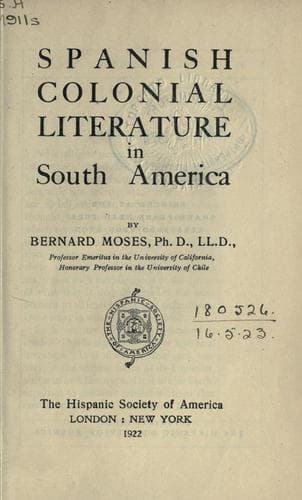
Spanish colonial literature in South AmericaMoses, Bernard
History
Spanish colonial literature in South America
Moses, Bernard
Spanish American literature -- History and criticism
The influences of colonial life generally stimulated practical activity
rather than philosophical or religious reflection, but now and then minds
appeared so predisposed to mysticism that they could not be awakened out
of their dreams even by the uproar of the frontier. Among such persons,
Medina mentions Ignacio García, Domingo Antomas, José Torres, Pedro de
Tula Bazán and Manuel Lacunza. García was born in Galicia in 1696,
studied at Coruña, entered the order of the Jesuits, and completed his
academic career at Salamanca. His request for service in America having
been granted, he sailed from Cadiz for Buenos Aires, and made the journey
of nearly a thousand miles from that town across the plains and over the
Andes into Chile. The first field of his mission was Coquimbó. From this
place he was transferred to Santiago, but in 1730 he was in Concepción,
where he gave instruction in philosophy. This was the year that witnessed
the destruction of Concepción by an earthquake, and after that event
García returned to Santiago, where he performed the duties of a professor
of theology. He died in that city in 1754 as rector of the Colegio
Máximo. His work entitled _Desengaño consejero_ was published in Lima the
year of his death. In this he emphasized especially the need of fervent
prayer, confirming this by citations from the Scriptures, and proposing
exercises for meditation in retirement. Another work of a similar
character was called _Respiración del alma en afectos píos_, which set
forth the exercises needed to keep alive the spirit, as respiration keeps
alive the body. In view of approaching death he requested Padre Javier
Zevallos to present to bishop Alday the manuscript of a volume entitled
_Cultivo de las virtudes en el paraíso del alma_ (Barcelona, 1759).
CHAPTER XV
GOVERNMENT AND LAW
I. _Melchor Calderón, Francisco Falcón and Francisco Carrasco
de Saz._ II. _Nicolás Polanco de Santillana, Juan Matienzo,
Juan de Solórzano Pereira, and Gaspar de Escalona y Agüero._
III. _The brothers Antonio, Diego, and Juan de León Pinelo
and Juan del Corral Calvo de la Torre._ IV. _Jorge Escobedo
y Alarcón and José Rezabal y Ugarte._ V. _Alonso de la Peña
Montenegro._
I
[Sidenote: Spanish autocracy]
[Sidenote: British and Spanish colonies compared]
[Sidenote: Rôle of Council of the Indies]
[Sidenote: Public discussion]
Public-domain text, read in full here on John Shaqi.
Reviews
Reviews
No reviews yet
Be the first to share your thoughts on this work.
Elsewhere in the archive
Join the Discussion
Join the discussion
Sign in to leave a comment or review.
Sign InorCreate an account