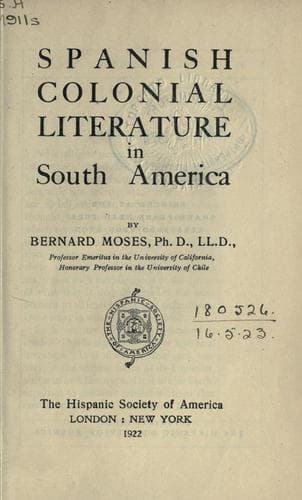
Spanish colonial literature in South AmericaMoses, Bernard
History
Spanish colonial literature in South America
Moses, Bernard
Spanish American literature -- History and criticism
last quarter of the seventeenth century. While the bulk of the references
are to the _Recopilación de los leyes de las indias_, other writings,
such as those of Matienzo, Acosta, and Torquemada, are frequently cited,
and, in keeping with the fashion of the times, there is embodied a
profusion of citations from classical authors. With all its superfluous
display of learning _Política indiana_ still holds and will continue to
hold a conspicuous place among the books of the first order for students
of the laws and government of the Spanish colonies in South America.
[Sidenote: Gaspar de Escalona]
[Sidenote: _Gazophilatium regium Perubicum_]
The third member of this group is Gaspar de Escalona y Agüero. It is
not positively known where he was born. Three cities have contended for
the honour of being recognized as the place of his origin. Alcedo, the
author of the geographical and historical dictionary, and the historian
Cevallos affirm that he was born in Ecuador, but other evidence points
to Lima as his native town. Wherever the honour may rest, it was
in the schools of Lima and the University of San Marcos that he was
educated. He held a number of public offices: he was corregidor of Jauja,
governor of Castrovireyna, procurador-general of the city of Cuzco,
and oidor, or judge, of the audiencia of Chile. His principal work,
entitled _Gazophilatium regium Perubicum_, was printed in Madrid in
1647; the first part in Latin, and the second part in Spanish. It treats
particularly of matters of justice, of questions concerning the civil
administration and the treasury, and of the affairs of the army. Its
analyses and descriptions present minute details both of the organization
and the functions of the public offices.
These writers were not reformers after the manner of persons who aim to
supplant the established government by a new form of administration;
they were loyal to the system which they served, but this loyalty did
not withhold them from criticising the practical execution of the
existing laws; they condemned with severity the criminal exactions of
the corregidores of Indians, and other abuses due to the dishonesty of
officials and their remoteness from the centre of superior authority.
[Illustration: Juan de Solórzano Pereira]
[Sidenote: The three works compared]
[Sidenote: Escalona’s book]
Public-domain text, read in full here on John Shaqi.
Reviews
Reviews
No reviews yet
Be the first to share your thoughts on this work.
Elsewhere in the archive
Join the Discussion
Join the discussion
Sign in to leave a comment or review.
Sign InorCreate an account