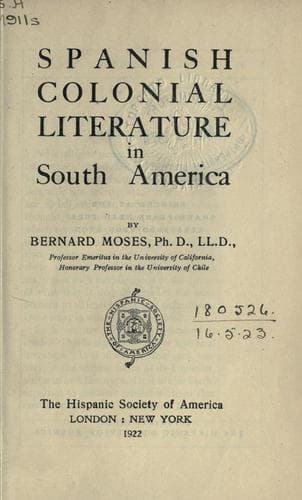
Spanish colonial literature in South AmericaMoses, Bernard
History
Spanish colonial literature in South America
Moses, Bernard
Spanish American literature -- History and criticism
“There are very important reasons for founding the audiencia of Charcas,
in addition to the one that had been established in the city of Lima;
for the Indians from the mountainous regions coming to Lima become ill
and many die from the effects of the climatic change; and, moreover,
for the Spaniards it is a great grievance to be obliged to go three
hundred leagues from those mountains to Lima, and five hundred leagues
from Tucumán and other places; and crimes ordinarily remain without
punishment, because of the distance from the court; and since the region
of Charcas adjoins the Chiriguanos, Indians hostile to the Spaniard
in neighbouring places, who have a great desire, if they were able to
do so, to return to Peru; and if the leaders were badly treated, they
might begin a war, and do a great amount of damage in the country. The
audiencia is there to resist them, and it is a great wall and defence.”
[Illustration: Title Page of Solórzano’s “De Indiarum jure”]
[Sidenote: Solórzano Pereira]
[Sidenote: _Política indiana_]
[Sidenote: Sources of _Política indiana_]
The second of the three important works mentioned is entitled _Política
indiana_, by Juan de Solórzano Pereira. He was a student, and later
an instructor, at Salamanca. In 1609 Philip III sent him to Lima as a
member of the audiencia in that city. Subsequently he became governor
of Huancavelica and inspector of quicksilver mining. After his return
to Spain and service in various offices, he was finally promoted, in
1629, to membership in the Council of the Indies. In the dedication of
his work to Philip IV he affirms that he was ordered to write, at his
discretion, on the subjects of law and government; moreover, that on his
return to Spain he caused to be printed two volumes in Latin entitled
_De Indiarum jure et gubernatione_, and that he was given to understand
that the king would be pleased and served if those books were translated
into Spanish, in order that they might be used by those persons who did
not understand Latin; and many persons by letter had expressed their
desire for such a translation. But on account of certain difficulties
attending the making and using a literal translation, he decided not
to bind himself to the letter of the Latin text, but to improve it by
adding to it in many places and by abbreviating it in others. In this
way was formed the text of _Política indiana_. In this form it treats of
the discovery, acquisition and retention of the Indies; of the natural
features of the continent; of the government; of the Indians, their
services under the Spaniards, and the tribute paid by them; of the tithes
and encomiendas; of the royal patronage; of the Church, the various
classes of ecclesiastical orders and their officers; and of the secular
magistrates: the viceroys, the presidents, the audiencias, and the
various councils and committees. The work thus appears as a digest of
the laws and decrees issued with application to the Indies prior to the
Public-domain text, read in full here on John Shaqi.
Reviews
Reviews
No reviews yet
Be the first to share your thoughts on this work.
Elsewhere in the archive
Join the Discussion
Join the discussion
Sign in to leave a comment or review.
Sign InorCreate an account