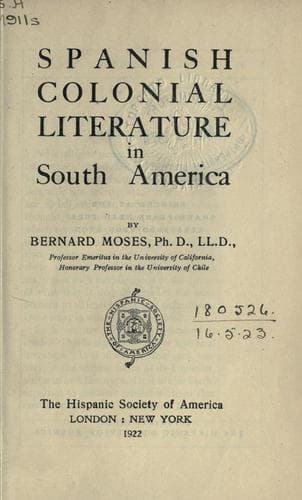
Spanish colonial literature in South America — John Shaqi
Spanish colonial literature in South AmericaMoses, Bernard
History
Spanish colonial literature in South America
Moses, Bernard
Spanish American literature -- History and criticism
Each century writes the literature it reads. This is especially true
of historical literature. It is also true that each century, in the
various forms of its literature, writes its own history; and it is to
this literature, not to the later critical writings that one must refer,
who would know how any given period of the past appeared to those then
living. It was once said of a distinguished modern historian of Rome that
he knew more about the affairs of Rome than the Romans themselves knew;
which was to say, that his works presented a view of Rome such as no
Roman ever had. The critical history of the society of any given period
of the past is so completely an artificial creation that it would hardly
be recognized by a member of that society. It takes its character, in a
considerable part, from knowledge, ideas, and emotions that were foreign
to him. Therefore, in order to know a nation’s life as known at any given
epoch, or to visualise the worldly show that passed before the thoughtful
contemporary mind, one should refer, not to the artificial creation of
the modern historian, with its twentieth-century atmosphere, but to what
men wrote of their own times or times near their own. Our ancestors’
vision of the world and the reaction which the world produced in their
minds are revealed in the various forms of their literature.
The material for an intellectual reconstitution of the view of their
society entertained by the Spanish colonists of South America is much
less abundant than that which the twenty-third-century historian will
have for reproducing our view of our times. There were in the Spanish
colonies no congressional or parliamentary debates, no popular orators
describing social conditions and setting forth economic and political
doctrines, no discussion of social programmes, and, more significant than
all else, no periodical press recording from day to day and from month
the events and ideas of the period in question. But in the books, the
reports, and the relaciones there is a larger mass of written evidence
than the comparatively rude state of colonial society would lead one to
expect; and it is the purpose of this book to point out the principal
documents of this colonial literature, and to introduce the reader to
the men of letters in the colonies who wrote under the inspiration of
their experience in the New World, whether their contributions were in
the realm of poetry, history, geographical description, or ecclesiastical
discussion. All this is brought together under a general title in which
the term “literature” is consciously expanded from its narrower meaning
to cover whatever was written on any of these general subjects; and by
helping the reader to a knowledge of this literature it is believed that
through it he will be enabled to acquire a more or less distinct view of
the colonial society as it appeared in any period to men of that period.
Public-domain text, read in full here on John Shaqi.
Reviews
Reviews
No reviews yet
Be the first to share your thoughts on this work.
Join the Discussion
Join the discussion
Sign in to leave a comment or review.
Sign InorCreate an account