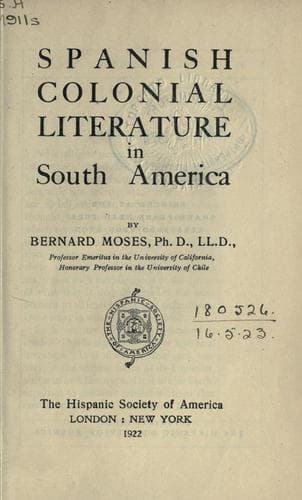
Spanish colonial literature in South AmericaMoses, Bernard
History
Spanish colonial literature in South America
Moses, Bernard
Spanish American literature -- History and criticism
Antonio’s brother, Diego de León Pinelo, became a professor in the
University of San Marcos and rector of that institution for the years
1656 and 1657. He was appointed Protector of the Indians, and later
fiscal of the audiencia of Lima. His extensive knowledge of legal
and ecclesiastical matters was generally recognized, and many of his
writings on juridical subjects were made public. In 1660 the Council of
the Indies sent Padilla’s letter to the viceroy, the letter treating of
the grievances, frauds, and acts of injustice under which the Indians
suffered. At the same time the king ordered that a commission should
be formed to examine the evils referred to, and seek a remedy. In
obedience to a request from the viceroy Diego de León Pinelo set forth
the misfortunes and extortions imposed upon the Indians. Pinelo’s report
and Padilla’s letter were printed at Lima. The amount of attention given
to this subject by the viceregal government may be inferred from the fact
that the decrees, complaints, and claims issued during Alva’s term as
viceroy, between 1655 and 1661, filled, when written, twenty-five books
with 9,660 leaves. The attention bestowed upon this subject gives some
indication of the extent of the abuses and excesses perpetrated by the
corregidores and parish priests.[195]
[Sidenote: Juan de León Pinelo]
The second brother of Antonio, Juan de León Pinelo, who, as already
indicated, studied at the University of San Marcos, became a cura at
Potosí, and later went to Spain with Antonio. He was subsequently
transferred to Puebla de los Angeles, and became a canon in the
Cathedral of that city. His writings, published and unpublished, deal
chiefly with ecclesiastical questions.[196]
[Sidenote: Corral Calvo de la Torre]
Juan del Corral Calvo de la Torre, born in the town of La Plata, in Upper
Peru, studied in Lima, and was granted the title of advocate by the
audiencia. He became a member of the audiencia in Santiago in 1698, and
while occupying this position prepared his extensive work, designed to
be three volumes in folio, under the title of _Expositio ac explanatio
omnium legum Recopilat Indiarum_. But his application for permission to
publish it received from the king the following reply:
[Sidenote: Royal refusal of manuscript]
Public-domain text, read in full here on John Shaqi.
Reviews
Reviews
No reviews yet
Be the first to share your thoughts on this work.
Elsewhere in the archive
Join the Discussion
Join the discussion
Sign in to leave a comment or review.
Sign InorCreate an account