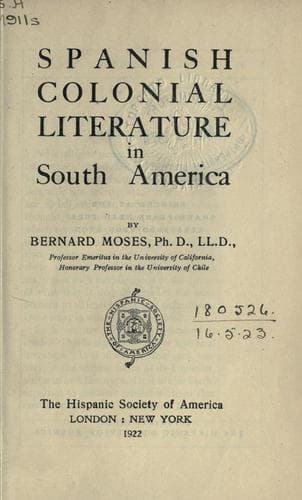
Spanish colonial literature in South AmericaMoses, Bernard
History
Spanish colonial literature in South America
Moses, Bernard
Spanish American literature -- History and criticism
“El Rey. Don Juan del Corral Calvo de la Torre, oidor de mi Audiencia
del reino de Chile. En carta de 1º de marzo del año próximo pasado, dais
cuenta del método que habéis observado en la ejecución de los comentos y
exposiciones de las leyes de las Indias, teniendo ya acabados dos tomos,
y el primero remitido a Lima, y para enviar el segundo; y habiéndose
visto en mi consejo de las Indias, con lo expuesto por su fiscal, se ha
considerado que la aprobación que pedís de esta obra, como el que sea
su impresión de cuenta de mi real hacienda, se debe suspender por ahora
hasta tanto que se vea y reconozca, en cuyo caso, y siendo digna de darse
a la prensa, se podrá ejecutar en España, para cuyo efecto la podréis ir
remitiendo en las ocasiones que se ofrecieren. De Madrid a 25 de mayo de
1726. Yo el Rey.”
[Sidenote: _Estado político del reino del Perú_]
A subject similar to Escalona’s is treated in an anonymous publication of
ninety-two folio pages entitled _Estado político del reino del Perú_; but
the treatment is of a very different character, and it is written with a
very different purpose. Escalona aimed to set forth a comprehensive and
impartial view of the political structure, and to describe it as it was
defined by law. The _Estado político_, on the other hand, is designedly
critical, as may be inferred from certain phrases from the long
sub-title, such as “government without laws, officials without industry,
treasures without poverty, fertility without cultivation, wisdom without
esteem, militia without honour, cities without patriotism, and justice
without a temple.” After these and other similar phrases, the author ends
his title-page with the remark that “these attributes constitute a grave
detriment to this kingdom, and as a remedy two expedients are proposed
to his Majesty by a loyal vassal who writes them, solely moved by a true
love of his prince and natural Lord, and for the greater good of the
kingdom of Peru and of his Patria Lima.” The first of these expedients
was a reform in the militia, or the military affairs of the kingdom; the
second was a reform in the commercial affairs.[197]
[Sidenote: The _Memorias_ by the viceroys]
The formal treaties on government and law are supplemented by a number
of public documents that have been printed. Important among these are
the _Memorias_ and _Relaciones_ delivered by the viceroys to their
successors. They present contemporary accounts of public affairs, the
actual state of the government, recent changes, and projects for future
modifications.[198]
IV
[Sidenote: Escobedo y Alarcón]
[Sidenote: Escobedo’s official positions]
Public-domain text, read in full here on John Shaqi.
Reviews
Reviews
No reviews yet
Be the first to share your thoughts on this work.
Elsewhere in the archive
Join the Discussion
Join the discussion
Sign in to leave a comment or review.
Sign InorCreate an account