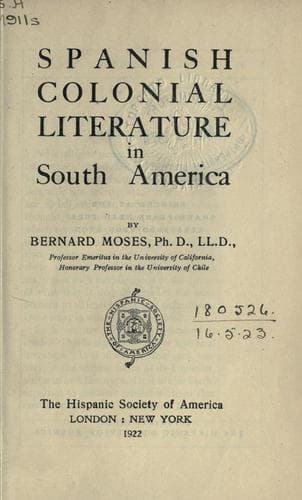
Spanish colonial literature in South AmericaMoses, Bernard
History
Spanish colonial literature in South America
Moses, Bernard
Spanish American literature -- History and criticism
I. _José Eusebio Llano y Zapata._ II. _Miguel de Olivares and
Pedro de Córdoba y Figueroa._ III. _José Pérez García and
Vicente Carvallo y Goyeneche._ IV. _Geographical description;
Molina and Vidaurre._ V. _Dionisio and Antonio Alcedo,
Zamacola, Segurola, and Martínez y Vela._ VI. _Concolorcorvo._
I
[Sidenote: Llano y Zapata]
[Sidenote: Zapata’s precocity]
[Sidenote: The Cadiz volume and letters of Zapata]
A notable figure of Peru in the eighteenth century was José Eusebio
Llano y Zapata. He was born in Lima, where his father held the office of
alcalde in 1690 and again in 1708. He appeared as the most precocious
mind of his time in Peru. At the age of nineteen he had published papers
on various topics in medicine, physics, and literature; and before he
was twenty-five he had added to these, among other writings, a panegyric
on Marcellos, bishop of Cuzco, the true method of preserving health, the
nature and origin of comets, a discussion on the books of Judith and
Isaiah, and the moral philosophy of Seneca. He possessed an extensive
knowledge of languages, and, as evidence of his interest in this branch
of study, he founded at Lima a public school for instruction in Greek.
In pursuit of knowledge of natural history he made extensive journeys
throughout South America during a period of five years, and afterwards
went to Spain, where he completed his most important book: _Memorias
histórico-físicas-críticas-apologéticas de la América meridional_, in
four volumes. The first volume (_Reino mineral_) was printed, the MSS.
of others have disappeared. In the second, the author is known to have
treated of the vegetable kingdom, “from the most magnificent tree to the
most humble plant”; in the third, of the animal kingdom, from the highest
to the lowest; in the fourth, the author described certain geographical
features of South America, particularly the great rivers, and in all
parts attention is given to the historical phases of the subject. A
little volume published at Cadiz in 1759 contains the preliminary
discourse of the first volume of the _Memorias_ and a number of Zapata’s
letters.
A more extensive collection of Zapata’s letters began to be published
at Cadiz in 1764. They present important details of a great variety of
subjects in the history of South America during the two centuries of
Spanish rule then completed.
[Sidenote: Support of Spanish system]
Zapata was an ardent champion of the designs and spirit of Spain’s
government of America. He praised the zeal of the conquistadores, excused
in some measure their faults, excesses, and avarice. He denounced the
writings of Las Casas as false and exaggerated, and condemned them
as utterances unworthy of a Spaniard. At the same time he showed an
appreciation of the Indians, maintaining that under a proper system of
instruction they would have manifested in the course of time “las fuerzas
del espíritu y la eficacia de la razón.”[201]
II
[Sidenote: Olivares’ career]
Public-domain text, read in full here on John Shaqi.
Reviews
Reviews
No reviews yet
Be the first to share your thoughts on this work.
Elsewhere in the archive
Join the Discussion
Join the discussion
Sign in to leave a comment or review.
Sign InorCreate an account