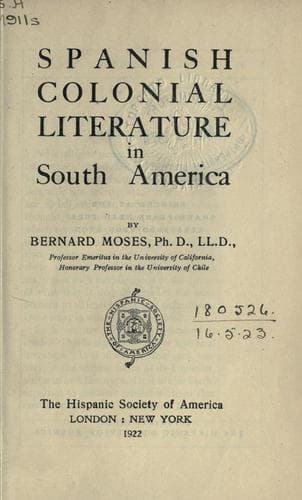
Spanish colonial literature in South AmericaMoses, Bernard
History
Spanish colonial literature in South America
Moses, Bernard
Spanish American literature -- History and criticism
Moreover, it is to Bishop Alonso de la Peña Montenegro that we are
indebted for an important treatise of this character, presenting what
may properly be called the constitutional position of the Church as a
part of the colonial organization, as determined by decrees, rules, and
regulations, particularly those affecting the doctrineros de Indios.
We have here in great detail the provisions elaborated and approved by
superior authority for fixing the duties of priests and missionaries in
the exercise of their functions in America, as well as the obligations of
all persons within the sphere of their ministerial influence. Although
the reciprocal obligations here defined may not in all cases have been
observed, still these provisions make clear the theory and expectation
of the superior authorities with respect to the ecclesiastical part of
the social organism. It is true that the inquiries of Juan and Ulloa
regarding this subject, which have been set down in their _Noticias
secretas de América_, throw much light on the departure of many priests
from the rules and regulations by civil or ecclesiastical authority,
nevertheless the law stands although it may be sometimes violated.
[Sidenote: Ecclesiastical functionaries]
The author describes the parish and the parish priest, discusses the
manner of electing the doctrineros de Indios, or missionaries to
the Indians, and shows the participation of the civil authority in
ecclesiastical affairs by pointing out the fact that “no archbishop,
bishop, prebend of any cathedral, doctrinero de Indios, or parish priest
in a parish of Spaniards may be appointed without first having been
presented by his Majesty, or persons empowered to represent him.”
[Sidenote: Topics of Peña’s treatise]
In this treatise other subjects of vital importance were considered,
such as the appointment of members of the regular clergy to the position
of missionary or parish priest; the mortal sin of accepting a mission
without knowing the language of the Indians; instruction in Christian
doctrine; questions concerning revenues and alms; preaching to the
heathen and their conversion; the functions of the priests respecting
the wills, or last testaments, of the Indians; the tribute, idolatry,
witchcraft, and drunkenness of the Indians; projects for extending the
dominion of the Church; the relation of the Indians to mining and work
in manufacturing establishments; provisions regarding discipline and the
ritual; and the vast array of problems that had arisen in the process of
organizing the church and adapting its ministrations to a people who had
no share in the heritage of Christian traditions.[200]
CHAPTER XVI
LATE EIGHTEENTH-CENTURY HISTORIANS
Public-domain text, read in full here on John Shaqi.
Reviews
Reviews
No reviews yet
Be the first to share your thoughts on this work.
Elsewhere in the archive
Join the Discussion
Join the discussion
Sign in to leave a comment or review.
Sign InorCreate an account