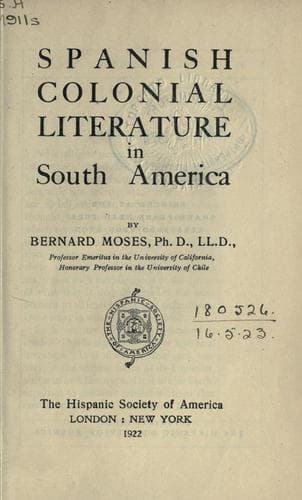
Spanish colonial literature in South AmericaMoses, Bernard
History
Spanish colonial literature in South America
Moses, Bernard
Spanish American literature -- History and criticism
Two writers on Chilean history during the last years of the colonial
period were José Pérez García and Vicente Carvallo y Goyeneche. Pérez
García was born in 1721, at Colindres, a little town in Spain near
Santander. His parents are described in their letters patent of nobility
as “_caballeros nobles, hijodalgos de sangre y naturaleza_.” He acquired
only the limited education ordinarily obtained by young persons who
intended to devote themselves to commerce. At the age of twenty he
left Spain for America in company with an older brother, who made a
considerable fortune in Upper Peru, and also conducted a commercial
house in Buenos Aires. For ten years Pérez García remained in that city
engaged in mercantile pursuits. Here he laid the basis of the fortune
that later insured his independence. About the middle of the century
he went to Chile, and continued his activity in mercantile affairs in
Santiago. Here his recognized honesty and his wealth acquired for him
an honourable position in the community, and his marriage with María
del Rosario Salas y Ramírez, the daughter of a rich Spanish merchant,
added to his fortune, and fixed his intimate relations with the most
conspicuous elements of Chilean society. After his withdrawal from active
business he continued to live in Santiago. In his retirement he sought
unsuccessfully from the king the rank and title of lieutenant-colonel,
not with a view of exercising the functions of command, but for the
sake of the social distinction this title would confer. One of the
characteristic features of this colonial society is seen in the
importance attached to titles and distinctive rank.
[Sidenote: Contents of García’s book]
[Sidenote: Lack of literary skill]
[Sidenote: Ground of García’s superiority]
Public-domain text, read in full here on John Shaqi.
Reviews
Reviews
No reviews yet
Be the first to share your thoughts on this work.
Elsewhere in the archive
Join the Discussion
Join the discussion
Sign in to leave a comment or review.
Sign InorCreate an account