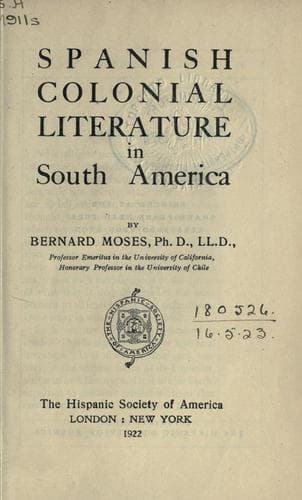
Spanish colonial literature in South AmericaMoses, Bernard
History
Spanish colonial literature in South America
Moses, Bernard
Spanish American literature -- History and criticism
The author of this diary was a Spaniard born in the province of Guipuzcoa
on January 27, 1740. He joined the army at the age of eighteen, and
after eighteen years of service left Spain for America in the force
commanded by Zeballos, when that officer, as viceroy of the newly created
viceroyalty of Río de la Plata, went to defend the Spanish settlements
against the encroachments of the Portuguese. Segurola had been decorated
with the cross of Calatrava and appointed corregidor of the province
of Larecaja; and after the conclusion of Zeballos’ campaign he entered
upon the duties of his provincial office, taking up his residence at the
town of Sorata, later destroyed by the Indians in the rebellion. While
at Sorata he learned of the outbreak of hostilities, and on January 1,
1781, he took command of the forces at La Paz and in the neighbouring
provinces, as directed by the president of the audiencia of Charcas.
After the rebellion Segurola remained at La Paz in the office of governor
and intendant that had been provided for in the reformed organization
of the viceroyalty. He was married in 1786, but his wife died two years
later at the birth of a second daughter. His death occurred the following
year. In recognition of his loyalty and his distinguished services, he
was admitted to the order of Santiago, appointed field-marshal, and
president of the audiencia of Charcas, but the notification of these
honours reached La Paz a few days after his death.
[Sidenote: _Anales de Potosí_]
In this first volume of the _Archivo boliviano_ appears also an important
document relating to the marvellous history of the city of Potosí, a city
that had been called into existence by the rich mines of Upper Peru. This
document is entitled _Anales de la Villa Imperial de Potosí_, and was
written by Bartolomé Martínez y Vela, a resident of Potosí. It is one
of the principal historical sources of Vicente G. Quesada’s _Crónicas
potosinas: costumbres de la edad mediæval hispano-americana_, and of the
author’s chapter called a _Mining Town in Upper Peru_.[208]
[Sidenote: The _Diario_ of Segurola]
The _Diario_ of Segurola contains the story of a critical event in the
Indian insurrection of 1780 and 1781, namely, the siege of La Paz. The
position of that city at the bottom of a great ravine in the inter-Andean
plateau gave a certain theatrical setting to the event. From the rim of
the cañon the Indians could look down into the city, and the inhabitants
from the fortified part of the town could watch the movement of the enemy
from day to day. The diary is an account of the flight of Spaniards from
neighbouring towns to La Paz as a place of refuge; of the formation of
a line of intrenchments enclosing the densely populated area of the
city, and of an exhausting defence continued for many months. Some idea
of the character of the narrative may be derived from the following
translations of daily entries:
[Sidenote: March 27, 28, and 29, 1781]
Public-domain text, read in full here on John Shaqi.
Reviews
Reviews
No reviews yet
Be the first to share your thoughts on this work.
Elsewhere in the archive
Join the Discussion
Join the discussion
Sign in to leave a comment or review.
Sign InorCreate an account