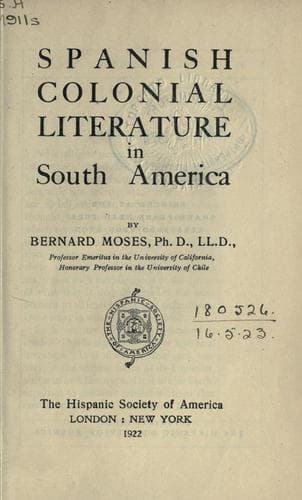
Spanish colonial literature in South AmericaMoses, Bernard
History
Spanish colonial literature in South America
Moses, Bernard
Spanish American literature -- History and criticism
“This year died in Potosí, that famous Señora, Doña Clara, commonly
called Amaltea, or Achacosa, who was at first a great sinner, extremely
rich, vain, and proud, and later very poor, humble, and virtuous. At
the age of twelve she became very well known not only in Potosí and
everywhere in Peru, but her fame extended also to Spain. She was,
moreover, beautiful, very discreet, lively, and agreeable; nature had
bestowed upon her all its gifts; she sang sweetly, played and danced
gracefully. She exercised a very great influence, since besides her great
patrimony as a woman of excellent standing she acquired at the cost of
her virtue immense wealth in gold, silver, jewels, precious stones,
pearls, and rich ornaments. She controlled everything, even the wills of
her associates, and was vain in the extreme; the various rooms and patios
in her house were sprinkled every day with scented water. The neatness of
her stables was such that one never saw in them even a straw. Continually
every day perfumed water was kept boiling in the porch and reception
rooms, in apple-shaped receptacles of silver, and there were braseros of
the same metal. She had as many chemises of fine linen from Holland and
Cambray as there are days in the year, and she put on a fresh one every
night. She had four rich bedsteads of wood and bronze with feather-beds
and draperies of beautiful cloths, and she changed from one to another
every three months. In a word, she was the most affluent woman in Potosí,
but these goods were acquired by a violation of the will of God, and in
the end pleasures of the world are such that even before they pass their
retribution appears; thus it happened to this famous woman; for in a
short time, by means it would be long to relate, she saw herself without
gold, silver, jewels, pearls, servants, and ornaments and what was more,
without even an old dress to hide her nakedness, and even more lamentable
still, her poverty was so great that she had not even a crust to eat,
and lived by charity, she whose weekly expenses in her house amounted
to two thousand pesos in daily banquets and other worldly pleasure. She
received from charity a skirt and an old chemise, cast-off finery, which
was no longer of use. She washed the clothes of strangers, because they
gave her food, she who had been disgusted on seeing a little spot on her
dress. She worked for even the humblest for a piece of bread, she who had
had white servants and many black female slaves, such an abundance of
servants, that two of them were employed solely in wiping up with towels
the spittle with which those who came to visit her had soiled the floor.
Finally she expiated in this life the disorders of her past, and suffered
with admirable patience her labours, giving by her experience a lesson to
the proud, the rich, and the avaricious, and thus she died very poor in
material goods, but rich in virtues. She was buried by the charity of her
noble and pious neighbours.
Public-domain text, read in full here on John Shaqi.
Reviews
Reviews
No reviews yet
Be the first to share your thoughts on this work.
Elsewhere in the archive
Join the Discussion
Join the discussion
Sign in to leave a comment or review.
Sign InorCreate an account