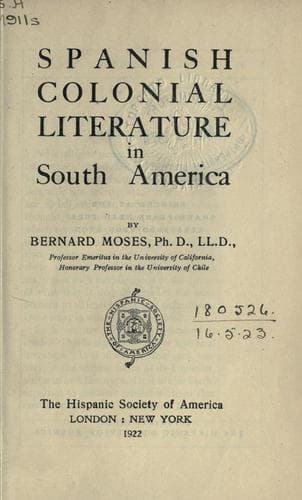
Spanish colonial literature in South AmericaMoses, Bernard
History
Spanish colonial literature in South America
Moses, Bernard
Spanish American literature -- History and criticism
I present this case to undeceive and correct
those who believe themselves secure in the possession of their temporal
goods.”
VI
[Sidenote: _El lazarillo de ciegos caminantes_]
_El lazarillo de ciegos caminantes_ is rather an elaborate guide-book
than a history. It treats of the route from Buenos Aires to Santiago de
Chile, but its principal subject is the south-eastern part of Spanish
South America, the region between Buenos Aires and Lima. It indicates
the various lines of communication, describes the towns, the roads, the
resources, the manners and customs of the country traversed, and the
difficulties, privations, and dangers of a journey over this route. The
style is plain and direct, the writer’s point of view is often humorous,
and his references are now and then vulgar; but the clearness of his
descriptions and the picturesqueness of the lighter parts make the book
eminently readable. As a contemporary account of the Peruvian cities in
the last half of the eighteenth century it has no successful rival.
[Sidenote: Concolorcorvo]
By the title-page of the original edition one is informed that the book
was written by Don Calixto Bustamante Inca, alias Concolorcorvo, and that
it was printed in Gijón in 1773. But, in spite of this reference to Gijón
it is held that it was printed in Lima. A new and excellent edition was
issued by the historical and numismatic society of Buenos Aires in 1908.
[Sidenote: Dialogue with Alonso Carrión]
The author was born in Cuzco. As a youth he visited Lima, and soon
afterwards set out for Spain, where he affirmed he had an uncle who was
an Indian of the royal Inca family; but learning of the death of this
unnamed uncle, he went on this occasion only as far as Buenos Aires.
Later he undertook the voyage to the Peninsula and returned from Coruña
to Montevideo in the ship “El Tucumán.” From Buenos Aires to Lima
he accompanied the visitador Alonso Carrión de Lavandera, to whom he
frequently makes reference in describing this journey, and who figures
in certain passages in a dialogue with the author. Carrión had been
commissioned by the king to arrange the affairs of the postal service
preparatory to its passing from private hands to the crown. Bustamante,
who assisted Carrión, took this occasion to gather at least a part of the
information set down in his description of the country traversed, and
much of this information refers to the existing postal service and the
special need of it at certain points.[209]
[Sidenote: The merits of Lima and Cuzco]
The following extract gives some indication of the author’s manner.
Public-domain text, read in full here on John Shaqi.
Reviews
Reviews
No reviews yet
Be the first to share your thoughts on this work.
Elsewhere in the archive
Join the Discussion
Join the discussion
Sign in to leave a comment or review.
Sign InorCreate an account