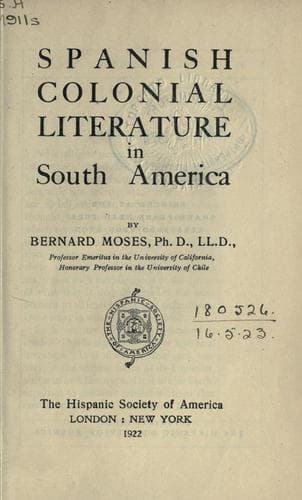
Spanish colonial literature in South AmericaMoses, Bernard
History
Spanish colonial literature in South America
Moses, Bernard
Spanish American literature -- History and criticism
_Siripo_ takes its title from the leading character of the drama, one
of two caciques, Mangore and Siripo, of the tribe of Timbu, pacified
residents at the fort of Santo Espíritu, who both conceived an ardent
passion for Lucía Miranda, the wife of the Spaniard Sebastián Hurtado.
These pacified savages traitorously get possession of the fort in the
absence of Hurtado. Lucía remains the captive of Siripo on the taking
and burning of the fort, but Hurtado returns and is persuaded that Lucía
still lives. He goes in pursuit of her and gives himself over to the
caciques, with whom he finds Lucía. The previous appearance on the scene
of Miranda, the father of Lucía, with a suggestion that Siripo shall
become a Christian on condition of receiving the hand of Lucía, although,
aside from the main story, is too grim a proposition to be thought of as
furnishing the comedy element of the play. Hurtado and Lucía are unable
to conceal their mutual affection, and the savage jealousy of Siripo is
aroused. The drama was played at several towns in Argentina, but only a
fragment of it has been preserved. The text of a few scenes have been
printed by Gutiérrez.[220] The following lines, a part of the twelfth
scene of the second act, will give a sufficient idea of Lavarden’s verses:
[Sidenote: Act II, Scene 12]
LUCÍA (_apresurada_).
Compasivo es mi Dios con una ingrata?
Respiras todavía, esposo amado?
Aún duran mis delicias, dueño mío?
Mis lágrimas los cielos apiadaron.
Cómo evitaste a Lambaré sangriento?
Te miro y me parece que es milagro.
Sin duda te herirían (_abriéndole la ropilla_) y por eso
En venirme a buscar has sido tardo.
HURTADO (_lloroso_).
Hiciéronme creer mis camaradas
Que murieras la noche del asalto.
LUCÍA.
Qué, tu lloras mi bien? Y qué la dejas
A mi terneza entonces? Los amargos
Fenecidos pesares no dilates
Que se tornaron gozos en tus brazos.
Sí, mi bien. Cuando en dulces soledades
De afanes tan crueles recorramos
El recuerdo, serán del amor nuestro
Testimonios que estrechen nuestros lazos.
HURTADO.
O consuelo infeliz! Consuelo estéril,
El monstruo del furor has abortado!
Más amargo, mi bien, hace este gozo
De nuestra desventura el triste plazo.
Me perdiste y te pierdo. Ya el cacique
Quien soy, sabe.
LUCÍA.
Mi Dios! Mas cuando te hallo
Constante y amoroso, esposo mío,
El morir junto a tí será regalo.
HURTADO.
Ello hemos de morir de alguna suerte,
Y, ya que es fuerza, con honor muramos.
Lucía, mi Lucía, muestra el cielo
Que ha tomado nuestra honra por su cargo.
Me mandó a confortarte. Ten presentes
Tu patria y religión, y cuánto te amo.
LUCÍA.
Qué, ya no me conoces? Tú me animas?
Dudas que alegre moriré a tu lado?
[Sidenote: French influence]
Public-domain text, read in full here on John Shaqi.
Reviews
Reviews
No reviews yet
Be the first to share your thoughts on this work.
Elsewhere in the archive
Join the Discussion
Join the discussion
Sign in to leave a comment or review.
Sign InorCreate an account