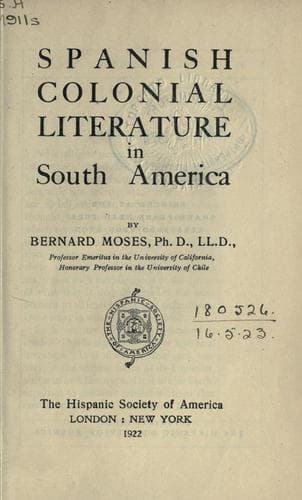
Spanish colonial literature in South AmericaMoses, Bernard
History
Spanish colonial literature in South America
Moses, Bernard
Spanish American literature -- History and criticism
José Orozco is probably the most widely known of the Ecuadorian poets.
He was born in Riobamba in 1733. His principal literary product was
the “epic poem” called _La Conquista de Menorca_. At nearly the same
time there was born in Ibarra a writer, Ramón Viescas, who as a lyric
poet held a place comparable with that held by Orozco as an epic poet.
Two other poets, Ambrosio and Joaquín Larrea, born about the middle of
the eighteenth century, became residents of Italy and in their later
writings made use of the Italian language. Although Juan de Velasco is
especially known for his _Historia del reino de Quito_, he left certain
mediocre writings in verse. He was born in Riobamba in 1727. The minor
poets are, like the poor, always with us, and among these in Ecuador in
the eighteenth century may be classed Juan Ullauri, Manuel Orozco, José
Gorrido and Nicolás Crespo.[218]
[Sidenote: Juan Manuel Lavarden]
The name of Juan Manuel Lavarden had passed almost completely out of
memory in Buenos Aires, when it was recalled by the publication of the
_Oda al Paraná_ in _El Telégrafo mercantil_. Later researches have
revealed very little concerning the youth and early education of the
author. He was known in Buenos Aires as a licenciado, honorary oidor
of the audiencia of La Plata, and auditor de guerra. The title of
_auditor de guerra_ was created by Philip V (1738), and first held by
Florencio Antonio Mereiras. It passed to Juan Manuel Lavarden, a lawyer
of distinction, under the approval of the king dated April 30, 1761.
Lavarden’s title to a place in the literary history of his country rests
on a _Sátira_, the drama of _Siripo_, and the _Oda al Paraná_.
It is through various persons that Lavarden voices his satire of
things colonial. The new nobles are among his victims. Resenting the
contemptuous attitude of Lima towards Buenos Aires, the poet was pleased
to point to the fact that in spite of the haughtiness and family pride
of the nobles they did not hesitate to abase themselves even by mingling
Spanish blood with the dark and turbulent blood that flows in the veins
of the daughters of Mozambique.[219]
[Sidenote: Political radicalism in poetry]
In some of the lines a political radicalism appears, which is a youth’s
anticipation, in 1786, of the revolutionary democracy of three decades
later:
El pueblo que de libre se gloría,
Produce nobles almas, que a ninguno
Quisieran conceder la primacía.
[Sidenote: Lavarden’s _Siripo_]
[Sidenote: The gist of _Siripo_]
Public-domain text, read in full here on John Shaqi.
Reviews
Reviews
No reviews yet
Be the first to share your thoughts on this work.
Elsewhere in the archive
Join the Discussion
Join the discussion
Sign in to leave a comment or review.
Sign InorCreate an account