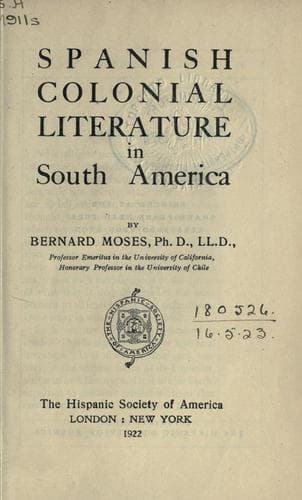
Spanish colonial literature in South AmericaMoses, Bernard
History
Spanish colonial literature in South America
Moses, Bernard
Spanish American literature -- History and criticism
Padre Francisco González Laguna was also a contributor to the _Mercurio_.
He wrote under the name of “Thiméo.” He had marked attainments as a
botanist, and participated in the work of the botanical expedition
directed by Ruiz and Pavón and in that of Malaspina’s expedition. The
plant _Gonzalaguna dependens_ was named in his honour by Hipólito Ruiz.
Laguna and Juan Tafalla were commissioned to arrange the botanical garden
of Lima. Besides articles published in the _Mercurio_, Laguna wrote
various papers on natural history and a work called _Celo sacerdotal
para con los no-nacidos_, in which one may find data with respect to the
number of missionaries who had perished at the hands of the Indians in
the wilds of Huanuco, Huamalíes, and Tarma; also an account of the exotic
plants that had been introduced into Lima during the previous thirty
years.
[Sidenote: Ignacio Lecuanda]
[Sidenote: Social confusion in Lima]
Another writer for the _Mercurio_ was José Ignacio Lecuanda, who held
various offices in Peru between 1782 and 1801; accountant in the
tribunal of accounts, treasurer of Guamanga, royal official accountant
at Trujillo, and later accountant of the customs at Lima. His articles
dealt with geographical questions, agriculture, industry and commerce. He
wrote also on matters of politics and administration. In the _Mercurio_
he published an account of the vagrants in Lima and of the means
proposed for employing them. He affirmed that in Lima two-thirds of the
inhabitants supported the rest, and that this state of vagabondage was
due to the freedom with which the inhabitants, the foreigners as well as
other classes, acceded to requests for charity, in this way developing in
large numbers of persons an unwillingness to work. The sons of artisans,
as well as many persons of other classes, refused to take up the careers
of their fathers. The women refused to work preferring to attach
themselves to families where they might obtain mere subsistence, or to
acquire a livelihood in some other way. The existence of distinct classes
added to the social confusion: the whites and the mestizos refused to
treat as their equals the negroes and the mulattoes, while these in turn
refused to undertake domestic service or labour in the fields, and
attempted to imitate the members of the dominant class.
[Sidenote: Chinchona]
Public-domain text, read in full here on John Shaqi.
Reviews
Reviews
No reviews yet
Be the first to share your thoughts on this work.
Elsewhere in the archive
Join the Discussion
Join the discussion
Sign in to leave a comment or review.
Sign InorCreate an account