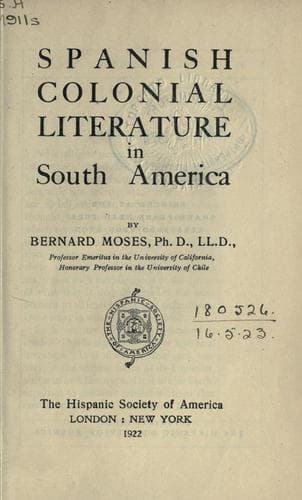
Spanish colonial literature in South AmericaMoses, Bernard
History
Spanish colonial literature in South America
Moses, Bernard
Spanish American literature -- History and criticism
This periodical contained also notable articles on quina. These appeared
in the eighth and twelfth volumes. Juan López Canizares is said to have
been the first European to acquire knowledge of the medicinal properties
of this plant, communicated to him by an Indian. In 1630, knowing that
the wife of the viceroy, the Condesa de Chinchón, was ill with an
exhausting intermittent fever, López sent a quantity of quina to the
viceroy, and this was administered to the countess by Dr. Juan de Vega,
with eminently satisfactory results. This incident induced Linnæus to
give the plant the name of Chinchona. Some of the bark in the form of
a powder was taken to Madrid, where it was examined by physicians and
rejected as a medicine. It was nevertheless used, and noteworthy cures
were effected. Here it was known as “pulvos de la condesa.” It was later
taken to Rome by Jesuits, and became known in Italy, France, and Germany
as Jesuits’ powder.
[Sidenote: Opposition to use of quina]
Some light is thrown on the spirit of the seventeenth century by its
reception generally in Europe. Persons who observed its effects could
not deny its efficacy, but they attributed these effects to a pact which
the Peruvians had made with the devil. It was discredited in France
and Germany; the English prohibited its use; and the learned men of
Salamanca maintained that it was an unpardonable sin for a physician to
prescribe it. Late in the eighteenth century, in spite of the fact that
Charles III tried to encourage the extraction of chinchona bark, certain
physicians in Spain continued to speak of it as a remedy that was worse
than the disease; but its properties had already attracted the attention,
and called forth the commendation of Dr. José Celestino Mutis, the
distinguished botanist of New Granada.[224]
[Sidenote: Gabriel Moreno]
Dr. Gabriel Moreno, a distinguished physician, who was born in Peru in
1735, occupied a prominent place among the scientific men of South
America during the last half of the eighteenth century. His special field
of research was Botany. The _Mercurio peruano_ contains an article on
coca by him. He published other papers and a series of biographies of
distinguished Peruvians: Francisco Ruiz Lozano, professor of mathematics;
Dr. Juan Ramón Koenig, the first cosmographer of Peru; and Dr. Cosme
Bueno, a physician of note in Lima. Dombey, who went to Peru with the
botanical expedition of 1778, dedicated a plant, which he discovered to
Dr. Moreno, calling it _Morena peruana_.
Public-domain text, read in full here on John Shaqi.
Reviews
Reviews
No reviews yet
Be the first to share your thoughts on this work.
Elsewhere in the archive
Join the Discussion
Join the discussion
Sign in to leave a comment or review.
Sign InorCreate an account